
Tips and Tricks
A Guide to Starting a Profitable Laser Engraving Business
Apr
Estimated reading time: 9 minutes
Key Takeaways
- Focus on high-demand, evergreen niches like personalized gifts, home decor, and wedding signage to ensure consistent sales year-round.
- Prioritize sourcing high-quality materials and pre-tested digital design files from reputable sources to produce premium products and reduce costly errors.
- Implement a systematic pricing formula (Material Cost + Machine Time Cost + Labor Cost) to cover all expenses and guarantee profitability for both standard products and custom services.
- Market your business with exceptional product photography on visual platforms like Etsy and Instagram, and build a reliable revenue stream by collaborating with local businesses and event planners.
Table of Contents
- Identifying the Most Profitable Laser-Cut Products
- Sourcing Quality Materials and Digital Designs
- Pricing Your Products and Custom Engraving Services
- Marketing Your Laser Engraving Business and Finding Customers
- Conclusions
- Frequently Asked Questions
Transforming a laser engraving hobby into a profitable business is an exciting journey. This guide provides a comprehensive roadmap, exploring the most popular products to sell, effective pricing strategies, and tips for finding customers. We will delve into everything you need to know to build a thriving creative enterprise from your workshop, focusing on high-demand items that will ensure your success.
Identifying the Most Profitable Laser-Cut Products
The key to a profitable laser engraving business isn’t just owning the machine; it’s knowing what to create with it. Identifying a profitable niche and focusing on best selling items laser cut will set you apart from hobbyists and establish a strong foundation for your venture. Instead of trying to be a jack-of-all-trades, focus on product categories with proven demand and high-profit potential.
Analyzing Evergreen Markets
Certain product categories enjoy consistent, year-round demand, making them a safe bet for any new business. The most lucrative of these are home decor, personalized gifts, and event-specific items. Home Decor is a massive market because people are always looking to personalize their living spaces. This includes items like intricate layered wood mandalas, custom family name signs, inspirational quote plaques, and holiday-themed ornaments. Personalized Gifts are arguably the most powerful niche for a laser business. The ability to add a name, date, or custom message transforms a simple product into a cherished keepsake, allowing you to charge a premium. This category thrives on holidays, birthdays, anniversaries, and milestones. Finally, Event Signage, particularly for weddings, is a high-growth area. Couples are willing to invest significantly in custom details for their special day, from large welcome signs and seating charts to smaller items like table numbers and cake toppers.
Interested in more Signs? Check out our Signs laser file designs: Click here!
High-Demand Products and Perceived Value
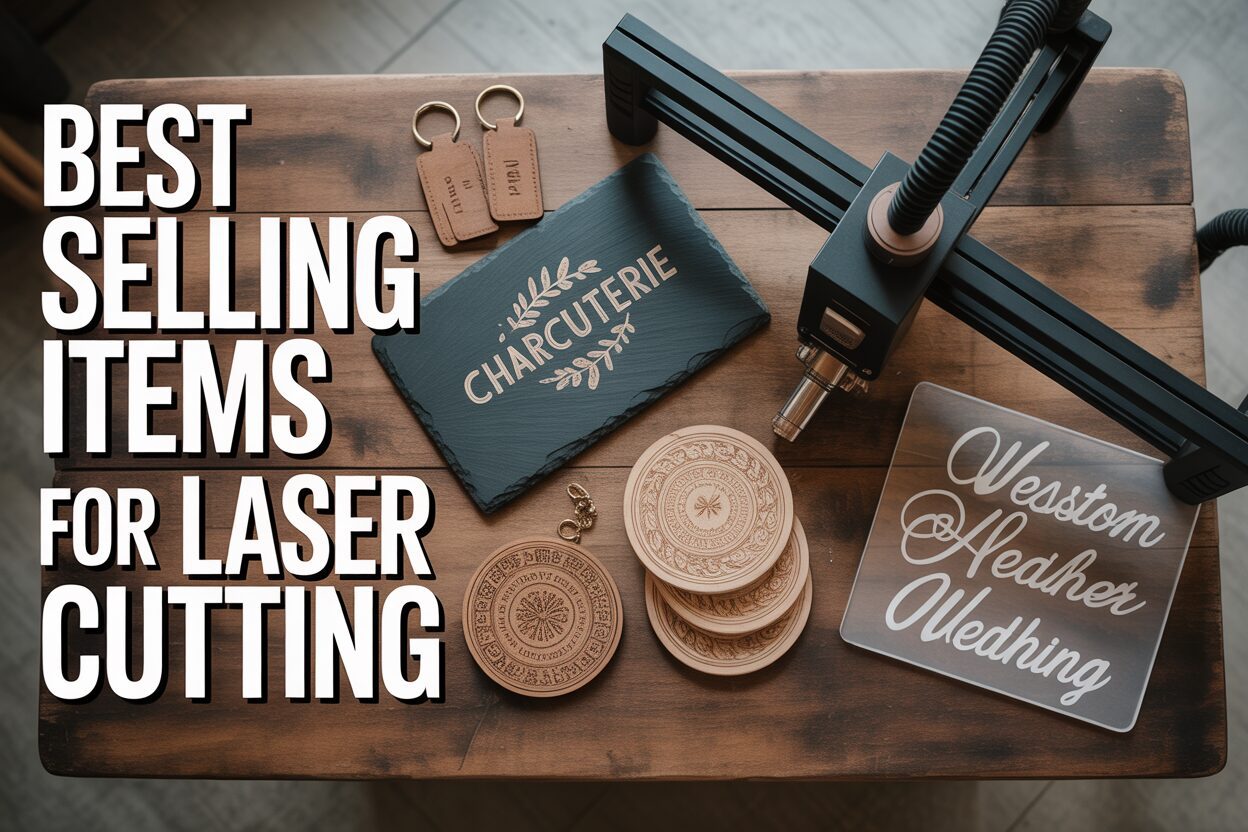
While the categories are broad, specific products consistently perform well. Focusing your initial efforts on these high-demand laser engraved gifts can generate early revenue and build your portfolio.
Here is a list of proven sellers:
- Custom Coasters: Made from slate, wood, or cork, these can be engraved with monograms, logos, or intricate geometric patterns. They are sold in sets, increasing the value of each transaction.
- Engraved Cutting Boards: A kitchen staple turned into a sentimental gift. Engraving a family recipe in a loved one’s handwriting, a “Established” date for a new home, or a decorative design makes these incredibly popular.
- Personalized Jewelry Boxes: A small wooden box with an engraved name or a meaningful quote on the lid has a very high perceived value and makes for a timeless gift.
- Custom Tumblers and Glassware: Using a rotary attachment, you can engrave names, logos, or designs onto powder-coated tumblers and pint glasses, catering to both individual buyers and corporate clients.
- Leatherette Goods: Items like wallets, keychains, and journal covers engrave beautifully, creating a high-contrast, premium-looking product with relatively low material cost.
The most profitable laser cut projects are those with high perceived value. This means the customer perceives the item as being worth much more than its material and production cost. This value is created through customization, intricate design, and quality craftsmanship. For example, a multi-layered wood art piece that creates a 3D effect seems far more valuable than a single flat piece of engraved wood, even if it only takes slightly more time and material to produce.
Leveraging Wood and Market Research
The popularity of wood laser engraving cannot be overstated. Wood offers a warm, rustic, and timeless appeal that resonates with a broad audience. Materials like birch plywood are cost-effective for layered art, while bamboo is excellent for cutting boards, and acacia or walnut adds a premium feel to high-end gifts.
To stay competitive, you must actively research what’s trending. Platforms like Etsy and Pinterest are your most valuable tools. On Etsy, search for terms like “laser cut wedding sign” or “personalized wood gift” and use the “Bestseller” filter to see what is currently popular. Pay attention to the aesthetics, fonts, and imagery that top sellers are using. On Pinterest, search for “laser engraving ideas” or “DIY home decor” to see what users are saving to their boards. This indicates aspirational trends and future demand. By analyzing what is already successful, you can identify gaps in the market and develop your unique product line that is primed for profitability.
Sourcing Quality Materials and Digital Designs
A stunning final product is born from two fundamental components: a flawless digital design and high-quality raw materials. Skimping on either will inevitably compromise the integrity of your work, leading to frustrated customers and wasted resources. Investing in premium inputs is not an expense; it is a foundational strategy for building a reputation for excellence and commanding higher prices for your products. The most sophisticated laser cutter cannot fix a poorly constructed design file or compensate for warped, inconsistent wood.
The Blueprint for Success: Sourcing Digital Designs
The quality of your laser engraving files is paramount. A professional file consists of clean, closed vector paths with no overlapping lines or stray nodes. This technical precision ensures the laser head moves efficiently, resulting in crisp engravings and perfectly smooth cuts. Conversely, a low-quality or poorly converted file can cause jagged edges, burn marks from a slow-moving laser, and frustratingly incomplete cuts. While free design files are abundant, they are often a false economy, costing you more in wasted material and time. For professional results, source your designs from reputable digital marketplaces. Etsy is a fantastic resource for unique, artist-created files. Other platforms like Creative Fabrica and Design Bundles offer extensive libraries, often on a subscription basis. The greatest advantage of purchasing from established laser designers is that their files are typically pre-tested. They often include detailed instructions with recommended power and speed settings for specific materials and laser wattages, which drastically reduces your learning curve and eliminates costly trial-and-error.
From Forest to Final Product: Finding Quality Materials
The tactile quality of your product is determined by the material you choose. For wood laser engraving, consistency is king. Baltic Birch plywood is a favorite among laser artists because it’s known for having minimal voids and a uniform thickness, making it ideal for projects that require precise cuts and assembly. For higher-end engraved items like keepsake boxes or charcuterie boards, solid woods like maple, cherry, and walnut provide a luxurious finish that justifies a premium price. Your local lumberyard can be a great starting point, allowing you to inspect the wood for warps and knots yourself. For more specialized or consistent “laser-ready” materials, online suppliers like Ocooch Hardwoods or Smokey Hill Laser are excellent resources. For other popular items, such as slate coasters, sourcing “blanks” is the most efficient method. Companies like JDS Industries or Johnson Plastics Plus specialize in providing ready-to-engrave items. Buying blanks saves you the labor-intensive step of cutting and finishing the raw material, allowing you to focus purely on the high-value customization. When vetting any supplier, whether for digital files or physical goods, always check reviews and, if possible, order a small sample batch first to ensure the quality meets your standards. Building a relationship with a few reliable suppliers will ensure your business can produce consistently excellent products for years to come.
Pricing Your Products and Custom Engraving Services
Pricing can be one of the most daunting aspects of launching your business, but a systematic approach can turn confusion into confidence. Underpricing devalues your work and cuts into your profits, while overpricing can deter potential customers. The key is to calculate your costs accurately and then factor in the value you provide. Your pricing structure must account for four critical elements: material costs, machine run-time, design work, and your manual labor.
Calculating Your Baseline Price
Before you can determine a profitable retail price, you must know your absolute break-even cost for every item you produce. A reliable formula to start with is: (Material Cost + Machine Time Cost + Labor Cost) x 2 = Wholesale Price. Then, Wholesale Price x 2 = Retail Price. This is a standard retail pricing model, but let’s break down the inputs.
- Material Cost: This is the most straightforward part. Calculate the cost of all physical materials used for a single item, including the wood, slate, leather, and even consumables like masking tape or wood finish.
- Machine Time Cost: Your laser is your primary employee and its time is valuable. To calculate this, determine an hourly rate for your machine. This should account for the machine’s purchase price amortized over its expected lifespan, electricity usage, and future maintenance (like replacing the laser tube). A common starting point is $1 per minute of run-time, or $60 per hour. Track the exact time it takes to cut and engrave an item to get this figure.
- Labor Cost: This is everything you do by hand. It includes the time spent setting up the design file, preparing and loading the material, post-processing like sanding or cleaning, and finally, packaging the item for shipment. Pay yourself a fair hourly wage for this time.
Once you have this baseline, you can confidently set prices knowing your costs are covered and you are building in a profit margin.
Pricing Standard Products vs. Custom Services
Your pricing strategy will differ between standardized products and bespoke, one-off jobs. For standardized products, like a batch of 100 wooden coasters with the same company logo, you benefit from economies of scale. The design setup time is a one-time cost distributed across all 100 units, making the labor cost per item very low. You might also get a bulk discount on materials. This allows you to offer a lower price per unit while still achieving a significant profit on the total order.
Conversely, a one-off personalized wedding welcome sign is a custom laser engraving service. This commands a much higher price because of the increased labor and perceived value. You will spend more time communicating with the client, creating mockups, and seeking approval. The design is unique, and the entire production process is dedicated to a single item. For these custom jobs, you should charge a specific design fee upfront or build a significantly higher labor cost into your pricing formula. The customer isn’t just buying a piece of engraved wood; they are buying a personalized centerpiece for a once-in-a-lifetime event, and your pricing should reflect that premium value.
Finally, it’s essential to research your competitors, but not to copy them. Look at the pricing on platforms like Etsy for similar items to understand the market range. Analyze what customers are willing to pay for high-quality, well-photographed products. Don’t engage in a race to the bottom. Instead, use competitive analysis to position your brand. If your materials are superior and your designs are more intricate, your price should be higher. Your price is a direct reflection of your brand’s quality.
Marketing Your Laser Engraving Business and Finding Customers
Once you have perfected your products and established your pricing, the next crucial step is connecting with customers. In a visually driven business like laser engraving, effective marketing is about showcasing craftsmanship and telling a story. You could create the most beautiful products in the world, but without a deliberate marketing strategy, they will remain unseen. The cornerstone of this strategy is exceptional photography. Your product photos are your digital handshake; they must be bright, clear, and styled to evoke the feeling you want your brand to convey. Invest time in learning basic product photography or hire a professional for your core product line—it is the single most impactful investment you can make in your marketing.
Choosing Your Digital Storefronts
Your marketing efforts should be focused on platforms where potential customers for laser engraved gifts are actively searching and browsing. You don’t need to be everywhere at once; mastering one or two platforms is more effective than having a weak presence on five. Etsy is the premier marketplace for handmade and personalized goods. It’s a powerful sales channel because users arrive with buyer intent, actively searching for products like yours. Success on Etsy requires understanding search engine optimization (SEO) by using relevant keywords in your titles and descriptions. Instagram is your visual portfolio. It’s the perfect platform to build a brand, share behind-the-scenes content, and connect with a community. Use high-quality images and video reels to showcase your work in a lifestyle context. For tapping into your local market, Facebook Marketplace and local community groups can be incredibly effective for selling larger items like wedding signage or for reaching customers who prefer local pickup.
Actionable Strategies to Attract a Steady Stream of Customers
Building momentum requires a consistent and multi-faceted approach. Integrating the following tactics into your marketing routine will help you build a recognizable brand and attract both individual buyers and valuable commission work.
- 1. Create a curated portfolio of your best work. Before you even launch, create a dozen or so high-quality sample pieces. These initial laser cut projects form your portfolio, demonstrating your skill and the range of possibilities you offer. This portfolio is your primary tool for social media, your Etsy shop, and for showing potential local partners.
- 2. Use relevant hashtags to increase discoverability. On platforms like Instagram, hashtags are how new customers find you. Use a mix of broad terms (#laserengraving, #wooddecor), niche-specific terms (#customcuttingboard, #weddingwelcomesign), and location-based terms (#chicagomaker, #austinweddings) to reach different segments of your target audience.
- 3. Prominently advertise your custom laser engraving services. Make it clear that you do more than sell pre-designed items. Many of your most profitable jobs will be custom commissions. Dedicate posts and listings to this service, showcasing past custom work and encouraging customers to reach out with their unique ideas.
- 4. Collaborate with local businesses and event planners. Reach out to complementary businesses. Partner with a real estate agent to become their go-to for client closing gifts (like personalized cutting boards). Connect with local wedding planners and venues to be their preferred vendor for custom signage and decor. These B2B relationships can provide a reliable stream of recurring revenue.
- 5. Leverage video content to show the “magic.” There is something mesmerizing about watching a laser at work. Short video clips of the engraving process make for incredibly engaging content on Instagram Reels, TikTok, or Facebook. This behind-the-scenes look builds a connection with your audience, highlights the precision of your craft, and shows the care that goes into every item.
Conclusions
Launching a laser engraving business is achievable with the right strategy. By focusing on best-selling items, using high-quality designs, pricing your work intelligently, and marketing effectively, you can build a loyal customer base. Start by creating a few popular products, showcase them with excellent photography, and begin your journey toward a profitable and rewarding creative business today.
Frequently Asked Questions
Q: What are the most profitable products for a laser engraving business?
A: The most profitable products are in evergreen markets like personalized gifts (coasters, cutting boards, tumblers), home decor (wood mandalas, family name signs), and event-specific items, especially wedding signage (welcome signs, cake toppers). These items have high perceived value and consistent demand.
Q: How should I price my laser engraved products to be profitable?
A: A standard retail formula is: (Material Cost + Machine Time Cost + Labor Cost) x 2 = Wholesale Price, and then Wholesale Price x 2 = Retail Price. Calculate your machine’s run-time (a common rate is $1/minute) and pay yourself a fair hourly wage for all manual labor, including design, prep, and packaging.
Q: Where can I find high-quality designs for laser cutting?
A: It is best to source pre-tested digital files from reputable marketplaces like Etsy, Creative Fabrica, and Design Bundles. While free files exist, purchased files are professionally made, tested, and often come with recommended settings, which saves you significant time and wasted material.
Q: What is the best way to find customers for a new laser engraving business?
A: Focus on visual platforms where buyers look for custom goods, primarily Etsy and Instagram. Invest in high-quality product photography. To build a steady revenue stream, collaborate with local businesses like real estate agents (for closing gifts) and wedding planners (for custom event decor) to establish B2B partnerships.
Block "subscribe-popup" not found
