
Tutorials
Creating the Perfect Personalized Charcuterie Board with Laser Engraving
Mar
Estimated reading time: 12 minutes
Key Takeaways
- Choose the Right Wood: Opt for dense, closed-grain hardwoods like Maple, Cherry, or Walnut. These woods are food-safe, durable, and provide a smooth surface for crisp, clean laser engravings. Avoid open-grain woods like Oak and softwoods like Pine.
- Prepare Your Artwork Correctly: Use high-quality vector files (SVG) for your designs to ensure they can be scaled without losing sharpness. Always convert text to paths or outlines to prevent font substitution issues on the laser engraver’s computer.
- Test Your Laser Settings: The ideal power, speed, and DPI settings vary by wood type. Always perform a test engrave on a scrap piece of the same material to dial in the perfect settings for your desired look, preventing mistakes on your final piece.
- Apply a Food-Safe Finish: Finishing is a non-negotiable step for safety and longevity. Use a food-safe finish like mineral oil or a beeswax blend to seal the wood, prevent it from drying out, and create a hygienic, easy-to-clean surface.
Table of Contents
- Selecting the Best Wood for Your Board
- Designing and Preparing Your Artwork
- The Laser Engraving Process: Settings and Techniques
- Applying a Food-Safe Finish
- Conclusions
- Frequently Asked Questions
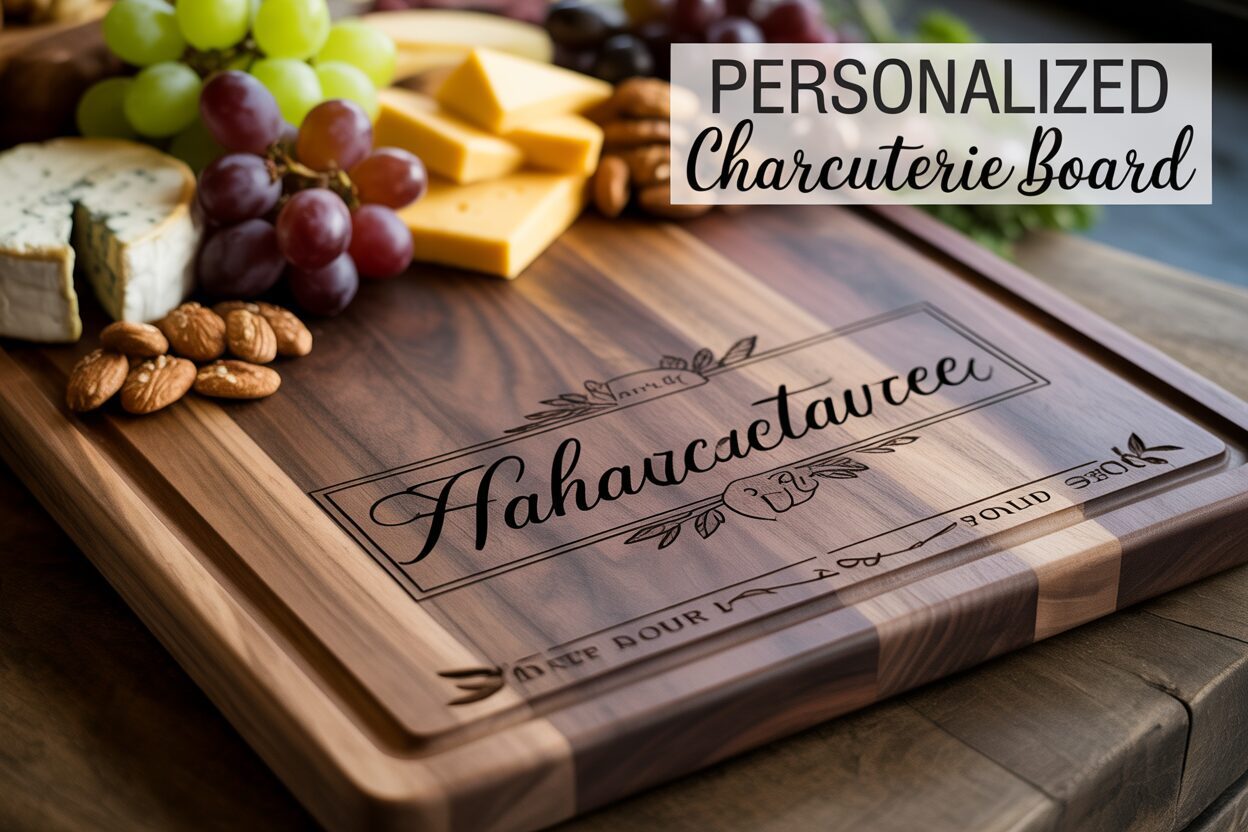
A personalized charcuterie board is more than just a serving platter; it’s a statement piece and a cherished gift. This guide will walk you through the entire process, from choosing the ideal wood to applying a food-safe finish. Learn how to use your laser engraver to create a stunning and functional work of art for any occasion.
Interested in more Charcuterie Board? Check out our Charcuterie Board laser file designs: Click here!
Selecting the Best Wood for Your Board
The foundation of any exceptional charcuterie board is, quite literally, the wood it’s made from. This choice is not merely cosmetic; it dictates the board’s durability, its safety for food contact, and how well your laser-engraved design will ultimately appear. Selecting the right material ensures your final piece is a perfect marriage of form and function—a beautiful keepsake that is also a safe and reliable serving platter. The key lies in understanding a fundamental characteristic of wood: its grain structure. For a project like this, your goal is to find a dense, closed-grain hardwood. These woods have very small pores, which prevents them from absorbing moisture and trapping food particles or bacteria. This makes them significantly easier to clean and sanitize, a non-negotiable trait for any surface that will come into contact with food. Furthermore, a tight, closed grain provides a smooth, uniform canvas for the laser, resulting in crisp, clean, and highly detailed engravings.
Top Choices for Engraving and Food Safety
When it comes to the best wood for laser engraving a custom cutting board, three hardwoods consistently stand out for their superior qualities: Maple, Cherry, and Walnut. Each offers a unique aesthetic while meeting the critical standards for durability and safety.
- Maple (Hard Maple): Often considered the gold standard, hard maple is an incredibly dense, durable, and light-colored wood. Its minimal grain pattern and creamy-white hue create the perfect high-contrast backdrop for laser engraving. The laser burn on maple produces a rich, dark brown to near-black mark, making your design pop with exceptional clarity. From a food-safety perspective, its non-porous nature is second to none, which is why it has been the traditional choice for butcher blocks for centuries.
- Cherry: If you desire a warmer, richer tone, cherry is an excellent choice. It features a smooth, satiny texture and a beautiful reddish-brown color that deepens with age and exposure to light, developing a lovely patina over time. The laser engraving on cherry is more subtle and elegant than on maple, creating a sophisticated, darker tone-on-tone effect rather than a stark contrast. It is still a very durable hardwood, perfectly suitable for serving and light cutting, and its closed-grain structure makes it completely food-safe.
- Walnut: For a luxurious, premium look, walnut is unmatched. Its deep, rich chocolate-brown colors, often highlighted by complex grain patterns and lighter sapwood, create a stunning visual statement. Engraving on walnut results in a very subtle, dark-on-dark effect. The design is less about contrast and more about adding texture and shadow, a sophisticated look that whispers quality. Like maple and cherry, walnut is a durable, closed-grain hardwood that is safe for food contact and will last a lifetime with proper care.
Woods to Strictly Avoid for Your Project
Just as important as knowing which woods to use is knowing which to avoid. The primary category to steer clear of is open-grain woods, with Oak being the most common example. While strong and beautiful, Red Oak in particular has large, porous vessels running through its grain. These pores act like tiny straws, readily absorbing moisture, oils, and bacteria from food. This makes the board nearly impossible to clean thoroughly, posing a significant food safety risk. From an engraving standpoint, these large pores also interfere with the laser’s path, causing the burn to look inconsistent and fuzzy, robbing your design of its intended sharpness and detail. Similarly, softwoods like pine are a poor choice. They are not durable enough to withstand knife use, denting and scratching easily, and their resinous sap can interfere with the engraving process and potentially leach into food. By sticking with a proven closed-grain hardwood, you ensure your personalized charcuterie board is not only beautiful but also safe and built to last.
Designing and Preparing Your Artwork
With your perfect piece of wood selected, the next step is to bring your creative vision to life. The design is what transforms a simple wooden board into a cherished personal item, a perfect gift, or a branded piece of serveware. The options for personalization are virtually endless, ranging from classic monograms and family names to significant dates, such as a wedding or anniversary. You can also add intricate floral patterns, a favorite quote, or even a cherished family recipe in a loved one’s handwriting. When sourcing your artwork, you have two primary paths: create it yourself using graphic design software, or find a pre-made design online. For the latter, searching for a charcuterie board svg file is your best bet. SVG stands for Scalable Vector Graphic, a file type that uses mathematical equations to define lines and shapes. This means you can scale a vector design to any size without losing a single bit of quality or sharpness—a critical feature for ensuring your engraving is crisp and professional. Raster files, like JPGs or PNGs, are made of pixels and will become blurry and jagged when enlarged, resulting in a poor-quality engraving.
Laying Out Your Design for Maximum Impact
Once you have your vector file, the next stage is placement and sizing within your chosen software, such as Adobe Illustrator for design work or directly within laser control software like LightBurn. The layout is just as important as the design itself. Begin by accurately measuring your charcuterie board and creating a digital representation of it on your software canvas. This allows you to visualize exactly how the design will look. Consider the board’s primary function. If it will see heavy use for cutting and serving, you may want to place the design in a corner or along an edge, keeping the main central area clear. For a board that is more decorative, a large, centered design can make a stunning statement. Use the software’s alignment tools to perfectly center your artwork or position it precisely relative to the edges. Pay close attention to scale; the design should feel balanced, not so small that it gets lost, and not so large that it overwhelms the natural beauty of the wood grain.
Finalizing Your Artwork for a Flawless Engraving
Before sending your file to the laser, a few critical preparation steps will ensure a perfect result. The most important of these is converting all text elements to paths or outlines. When you type text in a design program, it remains linked to a font file on your computer. If you move that design to the laser’s computer and it doesn’t have the exact same font installed, the software will substitute it with a default font, completely altering your design. By converting the text to paths, you change the letters from editable text into fixed vector shapes, locking in their appearance permanently. This guarantees that what you see on your screen is exactly what the laser will engrave. Finally, ensure your entire design is a single, solid color (typically black) and that there are no stray lines or open shapes. A clean, properly prepared vector file is the final and most crucial link between your digital idea and a beautifully finished engraved charcuterie board.
The Laser Engraving Process: Settings and Techniques
With your design finalized and your wood prepared, you have reached the most exciting stage: the laser engraving itself. This is where your digital creation is permanently etched into the board. The success of this step hinges on precision and a solid understanding of your laser’s settings. First, securely position your charcuterie board on the laser bed. Even the slightest shift during the engraving process can ruin the alignment and detail of your design. Use hold-down pins, clamps, or heavy weights placed carefully on the corners outside of the engraving area to ensure the board is completely immobile. Next, and equally critical, is focusing the laser. An improperly focused laser beam will be wider and less concentrated, resulting in a blurry, weak engraving rather than a sharp, crisp line. Use your machine’s focusing tool or auto-focus feature to set the correct distance between the laser lens and the surface of the wood. A perfectly focused beam is essential for achieving professional-quality results on your engraved charcuterie board.
Finding the Sweet Spot: Power, Speed, and DPI
The heart of the laser engraving process lies in dialing in the correct settings for your specific wood type. The three primary variables you will control are power, speed, and DPI (Dots Per Inch). These settings work in tandem to determine the depth, darkness, and quality of the final engraving.
- Power: This dictates the intensity of the laser beam. Higher power will result in a deeper, darker burn. However, too much power can cause excessive charring, creating a heavy, burnt look and potentially creating a fire hazard.
- Speed: This is the velocity at which the laser head moves across the wood. A slower speed allows the laser to dwell on each spot longer, creating a darker and deeper mark, similar to increasing power. A faster speed results in a lighter etch.
- DPI: This setting controls the resolution of your engraving, essentially how many lines the laser will engrave per inch. A higher DPI (e.g., 300-600) packs the lines closer together, creating a darker, more solid-looking fill, which is ideal for detailed graphics. A lower DPI will be faster and can create a more rustic, lined look.
Finding the perfect balance is key, and it varies for each wood. For a rich, dark engraving on a light wood like maple, you might use a combination of relatively high power and moderate speed. For a more subtle, tonal engraving on dark walnut, you would likely decrease the power or increase the speed. It is imperative to run a test cut on a scrap piece of the same wood before engraving your final board. Create a small test grid with different power and speed combinations to see exactly how they will look. This small step saves you from potentially ruining your project and allows you to choose the exact aesthetic you desire.
Once your settings are dialed in, send the job to the laser. Stay with the machine throughout the entire process, as wood is a flammable material. Ensure your machine’s air assist is on to help blow away debris and minimize flare-ups, and that your ventilation system is running effectively to remove smoke. After the laser has finished, your design will be covered in a fine layer of soot and resin residue. Before you even think about applying a finish, this must be cleaned off. A soft-bristled brush can remove the loose debris. For more stubborn residue, gently wipe the engraved area with a cloth lightly dampened with denatured alcohol. Be careful not to scrub too hard, which could smear the soot into the clean wood grain. A thorough cleaning at this stage is vital for ensuring your finish will apply evenly and your final piece looks pristine.
Applying a Food-Safe Finish
The laser has cooled and the engraving soot has been meticulously cleaned away, but your project is not yet complete. The final, crucial step is applying a finish. This isn’t just about making the board look good; it’s a non-negotiable step for longevity and, most importantly, safety. An unfinished wooden board is like a sponge. It will absorb moisture, oils from food, and bacteria, leading to stains, warping, cracking, and potential contamination. Applying a proper food safe wood finish creates a protective barrier that seals the wood’s pores. This barrier prevents the wood from drying out and cracking while also stopping moisture and bacteria from penetrating the surface, making your custom cutting board hygienic and easy to clean. Furthermore, the right finish will dramatically enhance the natural beauty of the wood, deepening its color, enriching the grain, and making your laser engraving stand out with a beautiful, subtle contrast.
Choosing Your Food-Safe Finish
When selecting a finish, your options are limited to products that are non-toxic and safe for direct food contact. Never use common woodworking finishes like polyurethane, varnish, or lacquer, as they are not food-safe. The best and most traditional choices are penetrating oils and waxes that nourish the wood from within. The most popular and effective options include: food-grade mineral oil, which is an inert, non-drying oil that saturates the wood fibers to prevent moisture absorption; beeswax, which can be melted and mixed with mineral oil to create a more water-resistant surface barrier; or a pre-made board cream or conditioner, which conveniently combines both mineral oil and beeswax (or other waxes like carnauba) into a single, easy-to-apply paste. For your first board, a high-quality, food-grade mineral oil is a perfect and straightforward choice.
The Application Process for a Perfect Sheen
Applying the finish is a simple but satisfying process that brings your personalized charcuterie board to life. Follow these steps for a professional and protective result:
- Step 1: Apply the Finish: Start with your board being completely clean and dry. Using a clean, lint-free cloth, apply a generous amount of your chosen oil or board cream to all surfaces of the board—the top, bottom, and all the edges. Use circular motions to work the finish into the wood, then wipe with the grain to ensure even coverage. Pay special attention to the engraved areas, making sure the finish penetrates the freshly exposed wood within your design. The wood should look wet and saturated.
- Step 2: Let it Penetrate: This is a step where patience pays off. Set the board aside and let the finish soak deep into the wood fibers. The ideal time is several hours, but for the very first coat on new wood, leaving it to penetrate overnight is best. You may notice some areas soak up the oil faster than others; feel free to apply more to these thirsty spots.
- Step 3: Buff to a Sheen: After the wood has absorbed all the oil it can, there will be a film of excess finish on the surface. Take a new, clean, dry cloth and thoroughly wipe off all this excess. If you leave it on, the surface will feel sticky or greasy. Once the excess is removed, continue to buff the entire board with the clean cloth. This action creates a bit of friction and warmth, bringing out a beautiful, silky-smooth, low-gloss sheen.
With this final step complete, your board is now fully protected, enhanced, and officially ready for use. This nourishing finish not only safeguards its structure but also transforms it into a rich, beautiful piece of functional art, ready to be the centerpiece of your next gathering.
Conclusions
You’ve now mastered the key steps to creating a beautiful, personalized charcuterie board. By selecting the right wood, preparing your design, and using a food-safe finish, you can produce a high-quality custom cutting board that’s perfect for personal use or as a memorable gift. Get creative and start your next laser engraving project with confidence.
Frequently Asked Questions
Q: What is the best wood for a laser-engraved charcuterie board?
A: The best woods are dense, closed-grain hardwoods like Maple, Cherry, and Walnut. They are food-safe, durable, and provide excellent, crisp results for laser engraving.
Q: Why should I avoid using oak for a cutting or charcuterie board?
A: Oak, especially Red Oak, is an open-grain wood. Its large pores can easily trap food particles and bacteria, making it difficult to clean and posing a food safety risk. These pores also cause laser engravings to look fuzzy and inconsistent.
Q: Do I need a special file type for my design?
A: Yes, it is highly recommended to use a Scalable Vector Graphic (SVG) file. Vector files can be resized to any dimension without losing quality, ensuring your engraving is sharp and professional. Raster files like JPG or PNG will become blurry when enlarged.
Q: What is the most important step before applying a finish?
A: After the laser engraving is complete, it is crucial to thoroughly clean the board to remove all soot and resin residue. This ensures the finish applies evenly and doesn’t trap debris, resulting in a pristine final product.
Q: Is polyurethane a food-safe finish?
A: No, common woodworking finishes like polyurethane, varnish, or lacquer are not food-safe and can be toxic. You must use a finish specifically rated for direct food contact, such as food-grade mineral oil or a blend of mineral oil and beeswax.
Block "subscribe-popup" not found
