
Tutorials
Creating the Perfect Personalized Charcuterie Board: A Laser Engraving Guide
Mar
Estimated reading time: 6 minutes
Key Takeaways
- Choose the Right Wood: Always select a dense, closed-grain hardwood like maple, cherry, or walnut. These woods are durable, food-safe, and produce high-quality engraving results. Avoid softwoods or open-grain woods that can trap bacteria.
- Prepare Your Design and Laser: Use vector files (SVG, AI) for crisp text and logos, and ensure any raster images (JPG, PNG) are high-resolution (300 DPI). Always run a test engrave on a scrap piece of the same wood to perfect your power and speed settings.
- Apply a Food-Safe Finish: Sealing the board is crucial for safety and longevity. Use a food-grade finish, such as a mineral oil and beeswax blend (board butter), to protect the wood and prevent it from drying out. Never use non-food-safe finishes like varnish or lacquer.
- Proper Maintenance is Key: To ensure your board lasts for years, hand-wash it with mild soap and dry it immediately. Never put it in a dishwasher. Recondition the wood monthly with a food-safe finish to maintain its protective barrier.
Table of Contents
- Choosing the Right Wood for Your Charcuterie Board
- Design Preparation and Laser Setup
- Engraving and Applying a Food-Safe Finish
- Conclusions
- Frequently Asked Questions
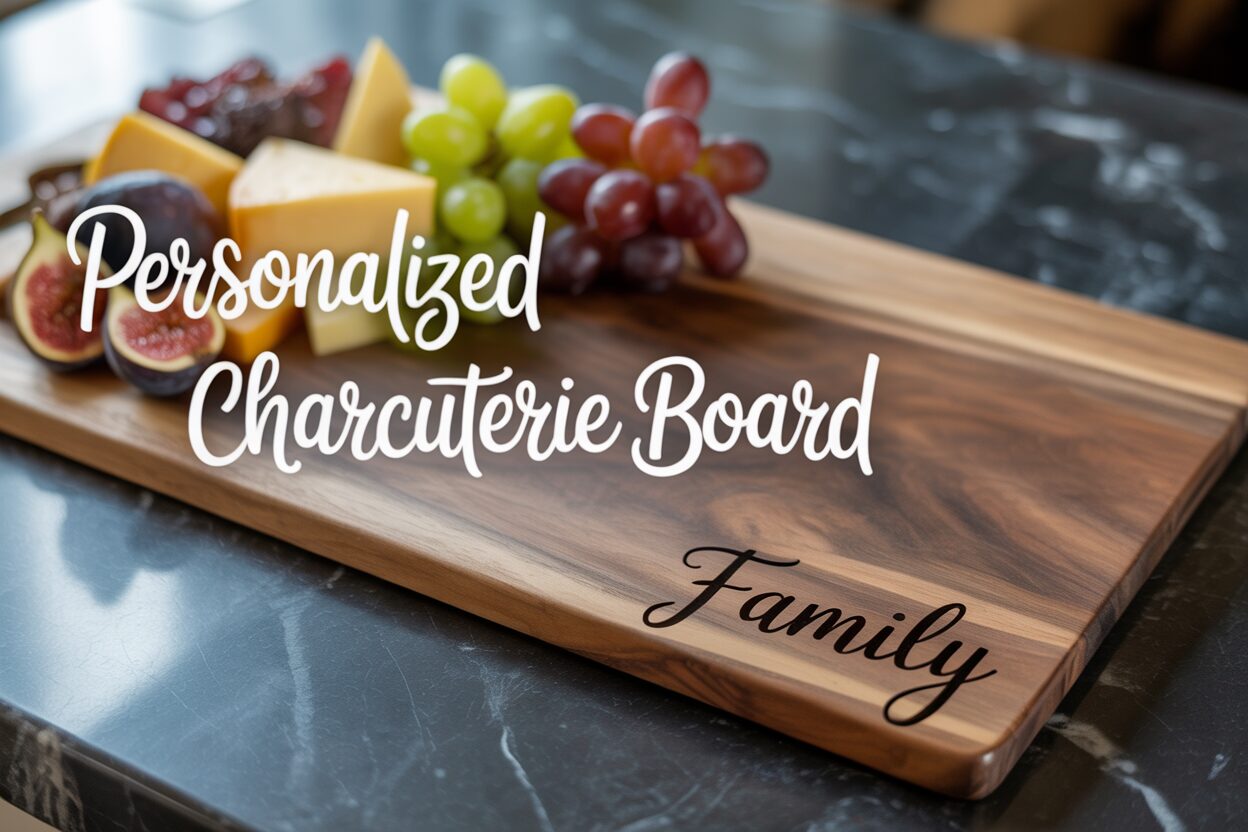
Elevate your hosting or gift-giving with a personalized charcuterie board. This guide will walk you through the entire process, from choosing the best wood to applying a food-safe finish. Learn how to use your laser engraver to turn a simple cutting board into a work of art, creating unique and memorable laser engraved gifts for any occasion.
Choosing the Right Wood for Your Charcuterie Board
The foundation of a remarkable personalized charcuterie board is, quite literally, the wood itself. While any piece of wood can be engraved, not all are suitable for serving food. The choice you make impacts not only the board’s aesthetic and durability but also its safety. The primary rule is to always opt for a hardwood. Sourced from deciduous trees, hardwoods are dense and durable, capable of withstanding the rigors of slicing, serving, and cleaning for years to come. Softwoods, like pine or cedar, are too porous and will easily scratch and dent, creating crevices where bacteria can thrive. Durability is key for a piece that is both a functional kitchen tool and a cherished keepsake.
Beyond simply being a hardwood, the ideal choice for a food-contact surface is a closed-grain wood. This term refers to the wood’s pore structure. Closed-grain woods have very small, tight pores that resist moisture, food particles, and bacteria from penetrating the surface. This makes them significantly easier to clean and sanitize, ensuring a food-safe environment. In contrast, open-grain woods like red oak have large, visible pores that can trap particles and become a breeding ground for germs, making them a poor choice for a custom cutting board. Always prioritize food safety by selecting a dense, closed-grain hardwood.
Top Wood Choices for Laser Engraving
When selecting your material, you’ll find that certain woods not only meet the safety and durability criteria but also yield stunning results under a laser. Each species offers a unique canvas for your design.
- Maple: Often considered the gold standard, hard maple is incredibly dense, durable, and has a fine, uniform grain. Its creamy, light color creates a high-contrast backdrop for laser engraving, making intricate designs and text appear crisp and dark. It’s a classic, reliable choice that delivers consistently beautiful results.
- Cherry: Valued for its smooth texture and rich, warm reddish-brown hue, cherry is slightly softer than maple but still very durable. It’s a beautiful wood that darkens and gains a deeper patina over time. Laser engraving on cherry produces a deep, rich tone that is slightly more subtle than on maple, offering an elegant and sophisticated finish.
- Walnut: For a luxurious and dramatic look, walnut is an exceptional choice. Its deep, chocolate-brown color and complex grain patterns make a statement on their own. Engraving on walnut creates a darker, tone-on-tone effect. While the contrast is lower than on maple, the result is a refined, high-end appearance perfect for a premium gift.
Sourcing Your Board: Pre-Made vs. Raw Lumber
Your final consideration is where to get your board. For most hobbyists, purchasing a pre-made, unfinished board blank is the most practical route. Look for boards from reputable suppliers that are already sanded smooth and constructed from a single solid piece or well-joined edge-grain strips. This ensures a stable, flat surface, which is crucial for a consistent engraving. An unfinished blank gives you complete control over the final sealing process after you’ve engraved your masterpiece. If you are an experienced woodworker with access to tools like a jointer, planer, and sander, sourcing raw lumber offers the ultimate freedom. This path allows you to create a completely unique shape and size for a truly custom cutting board, but it requires significant preparation to get the wood perfectly flat and smooth before it can be placed in the laser engraver.
Design Preparation and Laser Setup
With your perfect piece of wood selected, the next step is to bring your creative vision to life. This is where your engraved charcuterie board transforms from a simple plank into a personalized work of art. The design possibilities are endless, so take some time to brainstorm. Classic wood engraving ideas include elegant monograms for a wedding gift, a family name and established date for a housewarming, or the coordinates of a special place. For a more intricate touch, consider a floral border, a geometric pattern, or even a detailed family crest. A truly sentimental option is to digitize a handwritten family recipe, preserving a cherished memory in a functional format. Whatever you choose, the design should reflect the purpose of the board and the personality of its recipient, turning it into one of the most thoughtful laser engraved gifts you can create.
From Digital Canvas to Physical File
Once you have your idea, it’s time to prepare the digital file. Your laser engraver’s software will interpret this file to guide the laser. Understanding the difference between vector and raster images is crucial for achieving the desired result.
- Vector Files (SVG, AI, DXF, PDF): These are designs made of mathematical lines, curves, and points. They are ideal for text, logos, and line art because they produce incredibly sharp, clean edges. The laser follows these paths precisely. When working with text, always convert it to outlines or curves within your design software to ensure the font is treated as a shape, eliminating any potential compatibility issues.
- Raster Files (JPG, PNG, BMP, TIFF): These images are made of a grid of pixels, like a photograph. They are used for engraving detailed images, portraits, or artwork with gradients and shading. For a quality raster engraving, your image must be high resolution—at least 300 DPI (dots per inch) is recommended. The laser moves back and forth, firing at each pixel to build the image, similar to how an inkjet printer works. For most charcuterie board designs, which often feature text and logos, a vector file is the superior choice.
Regardless of file type, ensure your design is set to pure black (RGB 0,0,0) for the engraved portions, as this is what the software typically recognizes as the area to be lased.
Setting Up for Success: The Laser
Before you engrave your final piece, preparing the wood surface is a vital step. Even a smooth, pre-made board benefits from a final light sanding with 220-grit sandpaper. This removes any mill glaze or minor imperfections and opens the wood pores slightly for a more consistent burn. Afterward, thoroughly wipe the surface with a tack cloth or a lint-free cloth dampened with isopropyl alcohol to remove every speck of dust. A clean, smooth surface is essential for a flawless engraving. Next, secure your board in the laser bed, ensuring it is perfectly flat. Use a level if necessary. Correctly focusing the laser to the top surface of the wood is paramount for a crisp, detailed result. Finally, programming the correct settings is key. Power and speed will vary based on your laser’s wattage and the wood species. As a starting point:
- Maple: Being very dense, it requires higher power or slower speed. Try starting at 70% power and 300 mm/s.
- Cherry: This wood engraves beautifully and requires slightly less energy. A good starting point is 60% power and 350 mm/s.
- Walnut: This darker wood needs less power to avoid deep, heavy charring. Begin around 50% power and 400 mm/s.
Always run a test engrave on a scrap piece of the same wood before proceeding with your final board. This allows you to fine-tune your settings to achieve the perfect depth and color for your specific design and material.
Engraving and Applying a Food-Safe Finish
With your design perfected and your settings dialed in, it’s time for the most exciting step: watching the laser bring your creation to life. After a final check of your focus and positioning, secure the lid of your engraver and begin the job. It is crucial to remain with the machine while it is operating, not only for safety but to monitor the quality of the engrave. Ensure your ventilation system is running effectively to pull smoke and debris away from the wood surface, which prevents staining and results in a cleaner burn. Once the engraving is complete, let the board cool for a moment. You will notice some residue and soot inside the engraved areas. Before proceeding to the finishing stage, it’s important to clean this off. Use a soft-bristled brush (an old toothbrush works well) to gently scrub out the debris. For any lingering smoke haze on the surface around the design, a lint-free cloth lightly dampened with isopropyl alcohol will effectively wipe it away without damaging the wood.
The Critical Importance of a Food-Safe Finish
Now that the engraving is clean and crisp, the final step is to seal and protect the wood. This is arguably the most important part of creating a functional custom cutting board. You must use a food safe wood finish. This term refers to a finish that is non-toxic and will not leach harmful chemicals into food that comes into contact with it. Finishes like varnish, lacquer, or polyurethane are great for furniture but are not suitable for a surface used for cutting and serving. They can chip or flake off over time, potentially ending up in your food. A proper food-safe finish works by penetrating the wood fibers, hydrating them, and creating a protective barrier that repels moisture and food particles. This not only makes the board safer but also prevents it from drying out, cracking, and warping over time.
Application and Long-Term Care
The most popular and effective finish for charcuterie boards is a combination of mineral oil and beeswax blends, often sold as “cutting board cream” or “board butter.” This two-part system provides deep conditioning and surface protection. Here’s how to apply it for a beautiful, lasting finish:
- Initial Oiling: Start by applying a liberal amount of pure, food-grade mineral oil to all surfaces of the board—front, back, and all edges. The wood will be thirsty, so don’t be shy. Let the oil soak in for at least 4-6 hours, or preferably overnight. The oil will saturate the wood fibers, providing the primary layer of protection from within.
- Wipe and Condition: After the soaking period, use a clean cloth to wipe off any excess mineral oil that hasn’t been absorbed. Now, take a generous scoop of a beeswax and mineral oil conditioner. Using another clean, lint-free cloth, apply the conditioner in a circular motion, working it into the wood across all surfaces.
- Buff to a Sheen: Let the conditioner sit on the surface for about 15-20 minutes. Then, with a final clean cloth, buff the board vigorously. The friction will slightly warm the wax, helping it seal the surface and bringing out a beautiful, rich luster in the wood grain.
For long-term care, the board should be hand-washed only with mild soap and water and dried immediately. Never place it in a dishwasher. To maintain its protective barrier and vibrant look, reapply a coat of your board conditioner once a month or whenever the wood starts to look dry or dull. This simple maintenance will ensure your engraved charcuterie board remains a safe, beautiful, and functional centerpiece for years to come.
Conclusions
You now have the knowledge to create a stunning engraved charcuterie board. This project blends creativity with functionality, resulting in a unique piece that’s perfect for personal use or as a heartfelt gift. By following these steps, you can safely and beautifully craft a custom cutting board that will be cherished for years to come. Happy engraving!
Frequently Asked Questions
Q: What is the best type of wood for a charcuterie board?
A: The best woods are dense, closed-grain hardwoods like maple, cherry, and walnut. They are durable, resist bacteria, and provide excellent results when laser engraved. Avoid softwoods or open-grain woods that can easily scratch and trap food particles.Interested in more Charcuterie Board? Check out our Charcuterie Board laser file designs: Click here!
Q: Can I use any wood finish on my custom cutting board?
A: No, you must use a completely non-toxic, food-safe wood finish. A blend of food-grade mineral oil and beeswax is the most common and effective choice. Avoid finishes like varnish, polyurethane, or lacquer, as they are not safe for food contact and can chip off into food.
Q: What’s the difference between vector and raster files for engraving?
A: Vector files (like SVG or AI) are made of mathematical lines and curves, making them ideal for creating incredibly sharp text and logos. Raster files (like JPG or PNG) are made of pixels and are used for detailed images, such as photographs. For most charcuterie board designs featuring names or patterns, vector is the superior choice.
Q: How do I care for my engraved charcuterie board?
A: Always hand-wash your board with mild soap and warm water, and dry it immediately afterward. Never put it in a dishwasher or let it soak in water. To keep the wood protected and looking its best, reapply a coat of food-safe conditioner (like a mineral oil/beeswax blend) about once a month.
Block "subscribe-popup" not found
