
Tutorials
Creating the Perfect Engraved Charcuterie Board
Feb
Estimated reading time: 8 minutes
Key Takeaways
- Choose the Right Wood: Select a food-safe, closed-grain hardwood like maple, cherry, or walnut. These woods are durable, engrave beautifully, and are easy to clean, preventing bacteria buildup.
- Use a Vector File for Design: For a professional and crisp engraving, use a Scalable Vector Graphic (SVG) file. SVGs can be scaled to any size without losing quality, unlike pixel-based JPEGs or PNGs.
- Test Your Laser Settings: Always run a test on a scrap piece of the same wood before engraving your final board. Calibrating the power, speed, and focus is crucial for achieving the desired depth and contrast without scorching.
- Apply a Food-Safe Finish: After engraving, clean the board thoroughly and apply a food-grade finish like mineral oil or a mineral oil and beeswax blend. This protects the wood, enhances its beauty, and ensures it’s safe for serving food.
Table of Contents
- Selecting the Ideal Wood for Your Project
- Designing Your Custom Engraving
- Mastering the Laser Engraving Process
- Applying Food-Safe Finishes and Aftercare
- Conclusions
- Frequently Asked Questions
Discover how to transform a simple wooden plank into a stunning engraved charcuterie board. This piece is perfect for personal use or as a heartfelt gift. This guide will walk you through every step, from selecting the right wood and design to the final finishing touches, ensuring you can create a beautiful and functional work of art.
Interested in more Charcuterie Board? Check out our Charcuterie Board laser file designs: Click here!
Selecting the Ideal Wood for Your Project
The foundation of a stunning and safe charcuterie board is the wood itself. Your choice will influence not only the final aesthetic but also the board’s longevity, its reaction to the laser, and, most importantly, its suitability for serving food. The primary rule is to select a hardwood with a closed grain. Woods with large, open pores, like red oak and ash, can trap food particles and bacteria, making them difficult to clean and unhygienic for direct food contact. Closed-grain woods have much smaller pores, creating a smoother, less permeable surface that is easier to sanitize.
Top Wood Choices for Engraved Boards
When selecting your material, three hardwoods consistently stand out for their beauty, durability, and excellent engraving properties. Each offers a unique canvas for your design.
- Maple (Hard Maple/Sugar Maple): Often considered the industry standard for cutting boards, maple is an exceptionally hard, durable, and food-safe wood. Its light, creamy color and subtle grain pattern create a bright, clean canvas that makes laser engravings pop with striking contrast. When subjected to wood laser engraving, maple produces a rich, dark brown burn, ensuring your design is crisp and highly visible. Its density means it can withstand heavy use and knife marks well. The main downside is that its hardness may require slightly more laser power or slower engraving speeds to achieve the desired depth.
- Cherry: Known for its warm, reddish-brown hue and smooth, satin-like texture, cherry is another fantastic choice. It is slightly softer than maple but still very durable and develops a beautiful, deeper patina over time. Cherry engraves beautifully, producing a clean, dark mark that offers a more subtle, lower-contrast look compared to maple. This creates a sophisticated, elegant aesthetic where the design feels more integrated with the wood. Be aware that cherry wood is photosensitive and will naturally darken when exposed to light, which will further enrich the color of both the wood and the engraving.
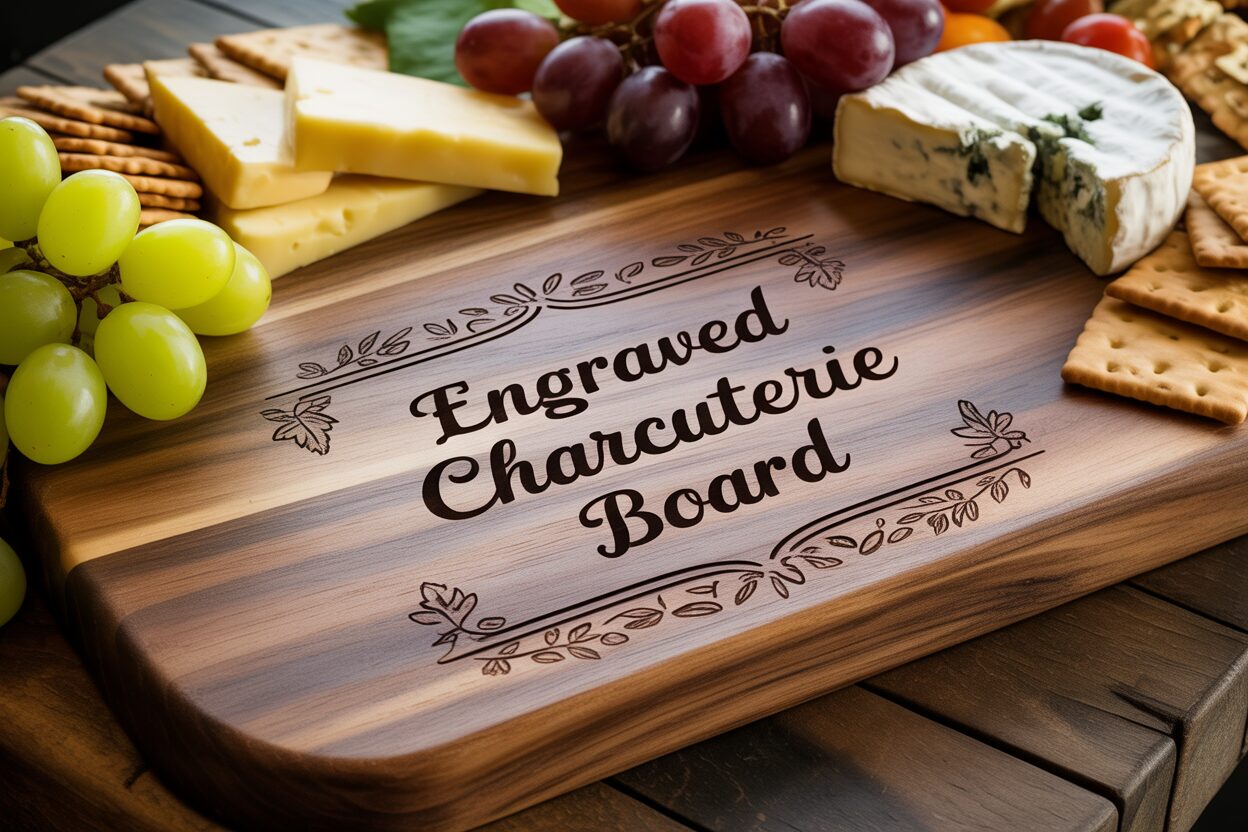
- Walnut: For a premium, luxurious feel, walnut is unparalleled. Its deep, rich chocolate-brown colors, often highlighted with complex grain patterns, provide a dramatic and upscale look. As a dark wood, the results from wood laser engraving are very different from maple or cherry. The engraved area will also be dark, creating a subtle, tone-on-tone effect. This sophisticated result is perfect for elegant monograms or intricate patterns that are meant to be discovered rather than announced. Walnut is a durable hardwood, though slightly softer than hard maple, and its fine, closed-grain structure makes it both food-safe and a pleasure to work with.
Tips for Sourcing Your Wood
Once you’ve decided on a wood type, you need to acquire it. You have two primary options, each with its own benefits. For beginners or those seeking convenience, purchasing a pre-made, unfinished board is the easiest path. Look for boards from kitchenware suppliers or specialty woodworking stores, ensuring they are advertised as cutting boards or cheese boards. Inspect them for a flat, smooth surface free of cracks, and confirm they are made from solid wood, not bamboo (which can engrave inconsistently due to its composition). For those wanting full control over the shape and size, sourcing raw lumber from a local hardwood dealer is the best choice. When selecting a piece of lumber, ensure it is kiln-dried to prevent future warping and check for major defects like large knots or cracks that could interfere with your design. This route requires more upfront work, as you will need to cut, plane, and sand the board to perfection before it’s ready for the laser.
Designing Your Custom Engraving
With your perfect piece of wood selected, the next step is to create a design that transforms it from a simple board into a work of art. The design phase is where your vision for a personalized charcuterie board truly comes to life. The key is to balance aesthetic appeal with the practicalities of the board’s shape, size, and intended use. Consider the board’s dimensions and any unique features like a handle or live edge. A design can be centered for a bold statement, placed discreetly in a corner for a subtle touch, or even designed to flow along an edge. Popular choices often include elegant monograms, family names with an established date, or meaningful quotes. For a more functional design, you could engrave a kitchen conversion chart or a decorative border that frames the serving area. The goal is to choose a design that complements the natural beauty of the wood, not overwhelms it.
Sourcing and Preparing Your Digital Design
To achieve a professional, crisp result, the quality of your digital file is paramount. While simple JPEGs or PNGs can be used, they are raster images made of pixels. When scaled, they lose quality, resulting in jagged or blurry edges in the final engraving. For superior results, you must use a vector file, and the industry standard is the charcuterie board svg (Scalable Vector Graphic) file. Unlike raster images, SVGs are based on mathematical equations that define lines and shapes. This means they can be scaled to any size without any loss of quality, ensuring the laser follows a perfectly smooth path. This is crucial for creating the clean, sharp lines that define a high-quality custom cutting board with engraving.
You can create your own SVG files using design software like Adobe Illustrator or the free alternative, Inkscape. However, for those who aren’t graphic designers, there is a vast market for pre-made laser engraving files on platforms like Etsy or specialized design websites. These files are often created by experienced designers and are already optimized for laser engraving, saving you considerable time and potential frustration. The real magic happens when you customize these templates. Most design software allows you to easily open an SVG and modify its components. You can take a beautiful floral border and insert a family name in a custom font, add a specific date to a wedding-themed design, or combine elements from multiple files to create something entirely unique. This process allows you to start with a professional foundation while still infusing the final product with a personal touch that makes it a truly one-of-a-kind piece. Always double-check your final design for any overlapping lines or unclosed paths, as these can cause errors during the engraving process.
Mastering the Laser Engraving Process
This is the moment where digital design meets physical craftsmanship. The wood laser engraving process requires precision, patience, and a bit of testing, but the results are incredibly rewarding. Before you even turn on the machine, proper preparation of your board is essential. Ensure the surface is perfectly smooth by sanding it with a fine-grit sandpaper (220-grit is ideal) and then wipe it down with isopropyl alcohol on a lint-free cloth. This removes any fine dust, oils, or residues that could interfere with the laser, ensuring a clean burn. Next, securely place your board inside the laser cutter. It must be perfectly flat and level relative to the laser head’s gantry. If the board is warped or sits at an angle, the focus of the laser will change as it travels, resulting in an uneven engraving depth. Use hold-down pins or create a simple jig to keep the board from shifting during the process.
Calibrating Your Laser Settings
Dialing in the correct laser settings is the most critical step for achieving a professional-looking engraved charcuterie board. The three main parameters you will control are power, speed, and focus. These settings work in tandem and vary significantly between different wood species. A dense wood like hard maple requires more power or a slower speed to achieve a deep, dark mark, while a softer wood like cherry might scorch if the settings are too aggressive.
- Power: This determines the intensity of the laser beam. Higher power results in a deeper and darker engraving.
- Speed: This is how fast the laser head moves across the wood. Slower speeds allow the beam to dwell on one spot longer, also resulting in a deeper and darker mark.
- Focus: A precisely focused laser creates the sharpest, finest lines. An out-of-focus beam will produce a wider, softer, and less detailed engraving. Always use your machine’s focusing tool before starting a job.
Before engraving your final piece, always run a test on a scrap piece of the exact same wood. Engrave a small test grid or a piece of your design using various combinations of power and speed to see how the wood reacts. For walnut, you might find that a lower power and higher speed gives a clean, subtle mark, whereas for maple, you’ll need to increase the power significantly to get that high-contrast burn. This testing phase is not optional; it is the key to avoiding costly mistakes on your final board.
Troubleshooting Common Engraving Issues
Even with careful preparation, you may encounter issues. The most common problem is scorching, which appears as a smoky “halo” around the engraved edges. This is caused by heat and wood resins staining the surface. The best way to prevent this is to apply a layer of medium-tack masking tape or paper transfer tape over the entire engraving area before you begin. The laser will cut cleanly through the tape, and after the job is done, you can simply peel it off, taking all the smoke residue with it. Another issue is uneven engraving depth. This is almost always caused by an uneven board surface or improper focus. Double-check that your board is perfectly flat and that you have focused the laser to the top surface of the wood. If your board has a slight warp, you may need to adjust the focus manually in the center to get the best overall result.
Applying Food-Safe Finishes and Aftercare
The laser has done its work, but the process of creating a truly finished piece is not yet complete. This final stage of finishing and sealing is what will protect your craftsmanship, deepen the wood’s natural beauty, and ensure the engraved charcuterie board is safe for serving food. Your first step after removing the board from the laser is a thorough cleaning. If you used masking tape, peel it away carefully. Use a soft-bristled brush (an old toothbrush works perfectly) to gently scrub out any charred residue or dust from within the engraved lines. A quick wipe with a cloth dampened with isopropyl alcohol can help lift any remaining smoke stains from the surface. Once clean, perform a final, very light sanding on the board’s surface with a high-grit sandpaper (220-grit or higher). Be careful not to sand over the engraved area aggressively, as this could soften the crisp edges. The goal is simply to create a silky-smooth surface, ready to absorb the finish.
Sealing and Protecting Your Board
Never use finishes like polyurethane, varnish, or lacquer on a surface intended for direct food contact, as they are not food-safe. The best choice for a charcuterie board is a penetrating oil that soaks into the wood fibers, protecting it from within.
- Food-Grade Mineral Oil: This is the most common and trusted option. It is an inert, non-toxic, and flavorless oil that will not go rancid like cooking oils (e.g., olive or vegetable oil). It beautifully enhances the wood’s grain and darkens the color, making the contrast of your engraving stand out even more.
- Mineral Oil and Beeswax Blends: Often sold as “board cream” or “wood butter,” these products offer the deep penetration of mineral oil combined with the surface protection of beeswax. The wax helps to fill the wood pores slightly more, providing better water resistance and giving the board a subtle, satin sheen.
To apply the finish to your personalized charcuterie board, start by pouring a generous amount of oil onto the clean, dry surface. Using a lint-free cloth, work the oil into the wood, moving in the direction of the grain. Be sure to cover every surface, including the sides, the handle, and deep into the engraved design. Let the board sit and absorb the oil for at least 30 minutes; for a new board, letting it soak overnight is even better. The wood will drink up the oil. After it has soaked, use a new, clean cloth to buff off all the excess oil until the surface feels dry to the touch. One coat is not enough. You should repeat this process three to four times for a new board, until it stops absorbing the oil as readily.
Long-Term Care and Maintenance
Proper care will ensure your charcuterie board lasts for years. The rules are simple but crucial. First, never submerge the board in water or put it in a dishwasher, as this will cause it to warp and crack. To clean it, simply wash by hand with mild soap and warm water, then immediately towel it dry. Store it upright in a dry place. Over time and with use, the board will start to look dry or faded. This is your cue to re-oil it. Simply repeat the finishing process with a single, generous coat of your mineral oil or board cream, let it soak in, and buff off the excess. For a board in regular use, a quick re-oiling once a month will keep it hydrated, hygienic, and looking as beautiful as the day you made it.
Conclusions
You now have the knowledge to create a beautiful, personalized charcuterie board. By selecting the right materials, using a quality design, and applying the correct laser techniques, you’ve made a lasting and functional piece. This engraved charcuterie board is not just a serving platter but a personalized statement, perfect for any occasion.
Frequently Asked Questions
Q: What is the best type of wood for a charcuterie board?
A: The best woods are dense, closed-grain hardwoods. Maple is excellent for high-contrast engravings, Cherry offers a warm, elegant look, and Walnut provides a luxurious, dark finish with subtle tone-on-tone engravings. All three are durable and food-safe.
Q: Do I need a special file type for my design?
A: Yes, for the best results, you should use a vector file, specifically an SVG (Scalable Vector Graphic). Unlike pixel-based images like JPEGs, SVGs can be resized without losing quality, which results in clean, sharp lines for your engraving.
Q: How do I prevent scorching or burn marks around my engraving?
A: The most effective method is to cover the engraving area with medium-tack masking tape or paper transfer tape before you start. The laser will cut through the tape, and when you peel it off afterward, it will remove all the smoke residue and prevent scorching on the wood surface.
Q: What is the best way to finish and care for my engraved board?
A: Always use a food-safe finish. Apply several coats of food-grade mineral oil or a mineral oil and beeswax blend. To care for the board, never put it in the dishwasher; wash by hand with mild soap and water, dry it immediately, and re-oil it once a month or whenever it looks dry.
Block "subscribe-popup" not found
