
Tutorials
Creating the Perfect Engraved Charcuterie Board
Feb
Estimated reading time: 10 minutes
Key Takeaways
- Select the Right Wood: Always choose dense, closed-grain hardwoods like Maple, Cherry, or Walnut for food-safe charcuterie boards. Avoid porous softwoods like pine, which can trap bacteria and engrave unevenly.
- Preparation is Crucial: A flawless result depends on proper prep. This includes creating a clean vector design, lightly sanding the wood surface, and running a test grid on a scrap piece to determine the perfect laser settings (Power, Speed, Focus) for your specific material.
- Safety First During Engraving: Never leave a laser engraver unattended while it’s operating, as wood is flammable. Ensure your ventilation system is running to safely remove smoke and particulates.
- Finish for Food Safety: The final step of sealing is non-negotiable. After cleaning the engraved residue, apply a food-grade finish like mineral oil and beeswax to protect the wood and create a hygienic, non-porous surface safe for serving food.
Table of Contents
- Selecting the Ideal Wood for Your Project
- Design Principles and Laser Preparation
- The Engraving Process Step-by-Step
- Finishing and Sealing for a Food-Safe Surface
- Conclusions
- Frequently Asked Questions
Discover how to transform a simple wooden board into a stunning engraved charcuterie board. This guide will walk you through selecting the right materials, mastering laser settings, and applying food-safe finishes. Perfect for creating personalized gifts or a unique centerpiece for your home, this tutorial will help you achieve professional-quality results on your laser engraved cutting board.
Interested in more Charcuterie Board? Check out our Charcuterie Board laser file designs: Click here!
Selecting the Ideal Wood for Your Project
The foundation of any stunning charcuterie board is the wood itself. Your choice of material will not only dictate the board’s durability and safety but will also dramatically influence the final appearance of your engraved design. When selecting a board for a project that involves both food and a laser, the primary focus should be on dense, closed-grain hardwoods. These woods provide a stable, non-porous surface that is less likely to trap bacteria and is strong enough to withstand regular use and cleaning. This is why they are considered the best types of wood for laser engraving when creating food-contact items.
In contrast, softwoods like pine, cedar, or fir should be avoided. Their porous, open-grain structure can harbor bacteria, making them unsuitable for direct food contact. Furthermore, softwoods often contain high levels of resin or sap, which can create an uneven, blotchy burn during laser engraving and may release undesirable fumes. Their inconsistent density, with alternating hard and soft growth rings, means the laser will engrave to different depths, resulting in a messy and unprofessional finish. Hardwoods, with their uniform density and fine grain, offer a smooth canvas for the laser, ensuring a crisp, consistent, and detailed engraving every time.
Comparing Top Hardwoods for Engraving
Among the many hardwoods available, three stand out for their exceptional performance in creating a laser engraved cutting board: Maple, Cherry, and Walnut. Each offers a unique aesthetic and interacts with the laser differently.
- Maple: This is arguably the most popular choice, and for good reason. Maple is a very hard, dense wood with a light, creamy color and a subtle, fine grain. This light background provides the perfect canvas for high-contrast engravings. The laser burns the wood to a rich, dark brown, making text and intricate designs pop with incredible clarity. Its hardness ensures that the engraved lines are sharp and clean with minimal bleeding or charring. If your design is detailed and you want it to be the undeniable focal point, maple is an excellent option.
- Cherry: Known for its beautiful, warm reddish-brown hue that deepens to a richer patina over time, Cherry offers a more subtle and elegant look. The engraving on cherry is typically a few shades darker than the wood itself, resulting in a sophisticated, tonal effect rather than a stark contrast. This makes it ideal for monograms, logos, or designs where you want the engraving to feel integrated with the wood’s natural beauty. It is slightly softer than maple but still provides a clean, consistent burn.
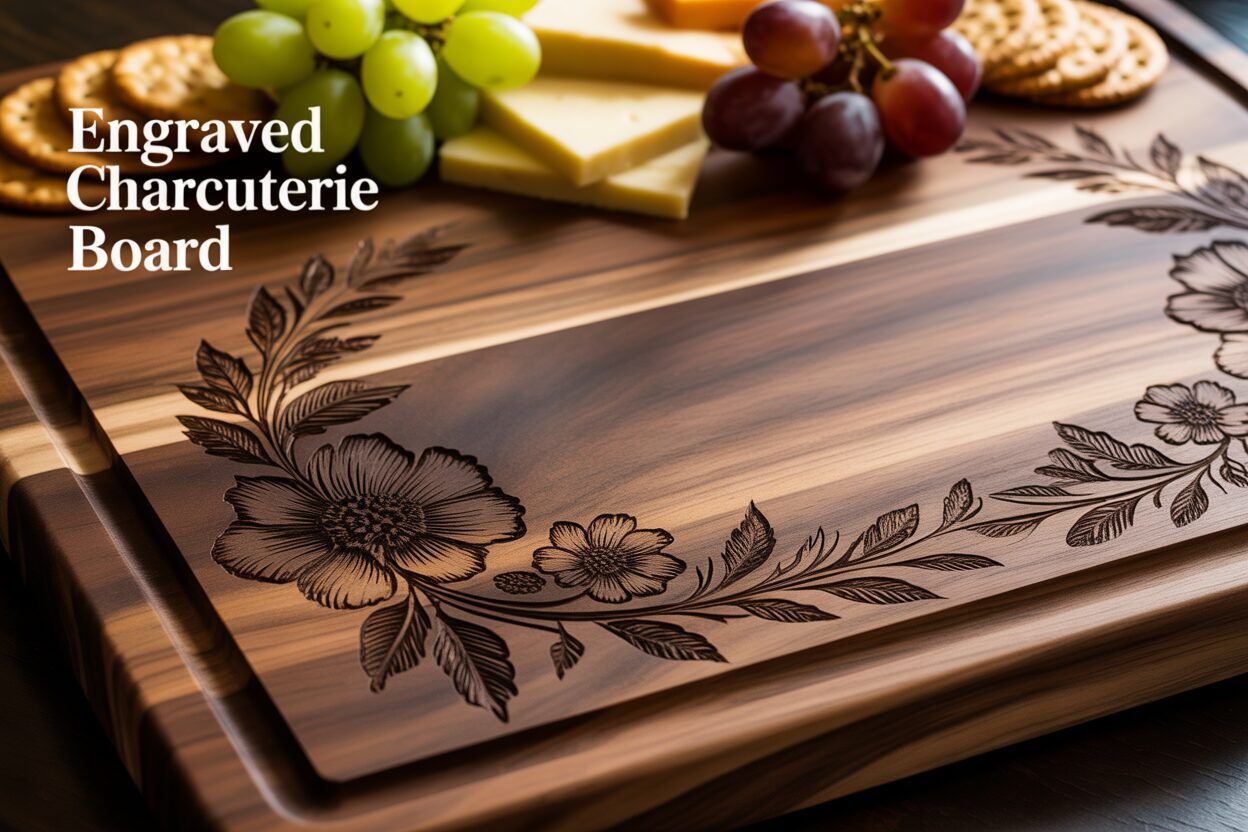
- Walnut: For a truly luxurious and premium feel, walnut is the top contender. Its deep, chocolate-brown color and striking grain patterns create a dramatic base. Engraving on walnut doesn’t produce high contrast; instead, it carves into the wood, creating depth and shadow. The resulting look is subtle, textural, and incredibly high-end. It’s perfect for a minimalist design that complements the wood’s inherent elegance.
Tips for Sourcing Your Wood
Finding the perfect blank board is a crucial step. When sourcing your wood, prioritize pieces that are untreated and unfinished. Many commercially sold cutting boards come pre-treated with oils or waxes that may not be food-safe after being burned by a laser. Look for raw wood blanks from specialty wood suppliers, local lumberyards, or online retailers specializing in craft woods. Always confirm that the wood has not been pressure-treated or finished with any chemicals. When you have a piece in hand, inspect it carefully. Ensure the board is perfectly flat to maintain a consistent laser focus across the entire surface. Check for knots, deep cracks, or significant imperfections in the area you plan to engrave, as these can interfere with the final result. Starting with a high-quality, properly prepared piece of wood is the key to a professional and food-safe finished product.
Design Principles and Laser Preparation
With your perfect piece of wood selected, the next stage is to translate your creative vision into a digital format and prepare both the design and the board for the laser. This phase is a blend of artistry and technical precision, where careful preparation is the key to a flawless result. The first step is deciding on a design. The beauty of a personalized board lies in its unique engraving, so consider the occasion and the recipient. Some popular and effective charcuterie board engraving ideas include:
- Monograms and Family Names: A classic choice for weddings, anniversaries, or housewarming gifts. Combining a large initial with the family name and an “established” date creates a timeless heirloom.
- Custom Logos or Artwork: Ideal for corporate gifts or for artists wanting to showcase their work. A clean, high-resolution logo can elevate a simple board into a professional branding tool.
- Favorite Recipes or Quotes: Engraving a cherished family recipe (like grandma’s salsa) or a meaningful quote about food and friendship adds a deeply personal and functional touch.
- Intricate Patterns: A geometric border, a floral vine design, or a damask pattern can add a touch of elegance, turning the entire board into a piece of art.
- Handwritten Messages: For the ultimate personalization, you can scan a handwritten note or a child’s drawing, convert it into a vector file, and engrave it directly onto the wood.
From Digital File to Physical Board
Once you have a design, it must be properly formatted for the laser engraver. Lasers work best with vector files (such as .SVG, .AI, .EPS, or .DXF) for text and line art, as these files use mathematical paths to create clean, scalable lines. For photographic or highly detailed images, a high-resolution raster file (like .PNG or .JPG) can be used. Regardless of file type, ensure your design is set to a pure black color (RGB 0,0,0), as this is what the laser software typically interprets as the area to engrave. It’s also crucial to convert any text in your design to outlines or curves. This turns the letters into shapes, ensuring the laser engraves them exactly as you see them, even if the machine’s computer doesn’t have the specific font installed.
Before you can engrave, the wood surface itself needs to be pristine. Even a high-quality board can benefit from a light sanding with 220-grit sandpaper. Always sand with the grain to avoid creating cross-grain scratches. This step removes any minor blemishes and creates a perfectly smooth surface, which allows for a more consistent engraving depth. After sanding, thoroughly clean the surface to remove all dust. A tack cloth is ideal, but a lint-free rag lightly dampened with denatured alcohol also works well to pick up any residual particles that could interfere with the laser beam.
Finally, you must determine the optimal laser engraver settings for wood. These settings—primarily Power, Speed, and Focus—will vary depending on the type of wood and your specific laser machine. There is no single magic number. The best practice is to always run a test grid on a scrap piece of the exact same wood.
- Power: This controls the intensity of the laser beam. Higher power results in a deeper, darker burn.
- Speed: This is how fast the laser head moves. A slower speed allows the laser to burn for longer in one spot, also creating a deeper, darker mark.
- Focus: A properly focused laser creates a tiny, concentrated point of light, resulting in sharp, crisp lines. An out-of-focus beam will produce a blurry, wide engraving.
By engraving a small grid with varying combinations of power and speed on your test piece, you can visually identify the setting that gives you the desired color and depth without excessive charring or “bleeding” into the wood grain. This small investment of time will prevent you from ruining your final project and guarantee a professional-quality result.
The Engraving Process Step-by-Step
With your design finalized and your wood prepared, you are ready for the most exciting part of the process: watching your creation come to life under the laser. This stage demands precision and a strict adherence to safety protocols to ensure you create a perfect engraved charcuterie board.
First, securely place your charcuterie board inside the laser engraver. It is absolutely critical that the board is perfectly level and cannot shift during the engraving process. Use a small bubble level to check it. If your machine has a honeycomb bed, the board should lie flat. If the board is warped, use shims or supports to make it level. Secure it in place using hold-down pins or a custom jig if you have one. Next, use your machine’s focusing tool to set the correct focal distance between the laser lens and the surface of the wood. An improper focus is one of the main causes of blurry or inconsistent engravings.
Before committing to your final piece, run your test grid on the scrap piece of wood you sourced earlier. Place the scrap in the engraver, focus the laser, and run the file with the various power and speed settings. Analyze the results to confirm which combination gives you the crisp lines and rich color you desire. Once you’ve selected your final settings, load your main design file into the laser software. A crucial, non-destructive step is to use the “frame” or “trace” function. This will move the laser head around the outer perimeter of your design without firing the laser, showing you exactly where the engraving will be placed on the board. Adjust the board’s position as needed until the placement is perfect.
Running the Job and Troubleshooting
Once you are confident with the placement and settings, you are ready to engrave. Follow this checklist before you press start:
- Double-check that your final power and speed settings are entered correctly in the software.
- Ensure your ventilation system or exhaust fan is turned on. Wood engraving produces smoke and particulates that must be safely vented away.
- Put on your laser safety glasses.
- Close the lid of the laser engraver.
Now, you can start the job. The most important rule of laser engraving is to never, ever leave the machine unattended while it is operating. Wood is a flammable material, and while rare, flare-ups can occur. Stay present and watch the process until it is complete.
Even with careful preparation, issues can sometimes arise. Here’s how to troubleshoot them:
- Uneven or Faded Engraving: If parts of the engraving are sharp and dark while others are light or blurry, it’s almost always a focus issue. This means the board was not perfectly level. The distance between the laser lens and the wood surface was changing, causing the beam to go in and out of focus.
- Excessive Burn Marks or “Halos”: If you notice a lot of dark charring or smoky residue around your engraved lines, your power setting is likely too high or your speed is too slow. This is why the test grid is so important. For future projects, you can also apply a layer of wide, laser-safe masking tape over the wood before engraving. The laser will cut through the tape, which will catch the surface residue, and you can simply peel it off afterward for a cleaner result.
- Design is Misaligned: This happens when the board shifts during the job or the initial framing step was skipped. Always ensure your material is securely fastened before starting.
Once the laser has finished its job and the machine is silent, wait a minute for the exhaust fan to clear any remaining smoke before opening the lid to retrieve your newly engraved board.
Finishing and Sealing for a Food-Safe Surface
The laser has done its work, but your project isn’t complete until it’s been properly cleaned and sealed. This final stage is non-negotiable, as it transforms your creation from a decorative piece of wood into a functional, durable, and food-safe serving vessel. The process of sealing engraved wood is essential for both hygiene and longevity. The laser vaporizes the wood, creating a porous, carbonized surface within the design. If left unsealed, these tiny crevices can trap food particles and bacteria, making the board unsafe for use. Furthermore, a proper finish protects the wood from drying out, cracking, and staining, ensuring your custom board will last for years to come.
Your first step after removing the board from the engraver is to clean the engraved area. The process leaves behind a residue of smoke and sap that can obscure the fine details of your design. Start by using a soft-bristled brush, like an old toothbrush or a nylon detailing brush, to gently scrub the engraved portions. This will dislodge any loose debris and char. Next, take a clean, lint-free cloth and lightly dampen it with denatured or isopropyl alcohol. Gently wipe the surface of the engraving. The alcohol is an excellent solvent for smoke residue and will evaporate quickly without raising the wood grain significantly. You will be amazed at how much cleaner and sharper the design looks after this step. Allow the board to air dry completely for at least an hour before proceeding.
Applying a Food-Safe Finish
Once the board is clean and dry, it’s time to apply a protective, food-grade finish. It is critical to use a finish specifically designed for food contact surfaces like a laser engraved cutting board. Never use standard woodworking finishes like polyurethane, lacquer, or varnish, as they are not safe for consumption. Here are the best options:
- Food-Grade Mineral Oil: This is the industry standard for conditioning cutting boards. It is an inert, non-toxic oil that penetrates deep into the wood fibers, hydrating them and preventing them from becoming brittle. It also begins the process of sealing the wood’s pores.
- Beeswax: Often used in conjunction with mineral oil, beeswax provides a more robust surface-level seal. It adds a layer of water resistance and gives the board a beautiful, silky sheen.
- Board Creams and Conditioners: These products offer the best of both worlds, typically combining mineral oil and beeswax (and sometimes other waxes like carnauba wax) into a single, easy-to-apply paste. They both moisturize and seal the wood simultaneously.
To apply the finish, start with a generous coat of mineral oil. Pour the oil directly onto the board and use a clean cloth to spread it evenly across all surfaces—top, bottom, and all four sides. Don’t be stingy; the wood, especially any exposed end grain, will be very thirsty. Let the board sit for several hours, or ideally overnight, allowing the oil to soak in as deeply as possible. The next day, use a dry cloth to wipe off any excess oil that hasn’t been absorbed. At this point, the board is technically finished, but for superior protection and a better feel, follow up with a board cream. Apply a small amount of the cream with a cloth, rubbing it in a circular motion over the entire board. Let it haze over for about 15 minutes, then take a final clean cloth and buff the surface vigorously. This will create a beautiful, low-gloss finish that feels smooth to the touch. You’ll notice that the finish dramatically enhances the wood’s natural color and grain, making the dark, engraved design pop with stunning contrast. Your charcuterie board is now beautifully finished, fully protected, and perfectly safe for serving.
Conclusions
You now have the skills to create a beautiful and personalized engraved charcuterie board. From choosing the best wood to applying the final food-safe seal, you can confidently tackle this project. This technique not only enhances your woodworking abilities but also allows you to produce memorable, custom pieces for gifts, sales, or personal enjoyment in your kitchen.
Frequently Asked Questions
Q: What is the best type of wood for a laser engraved charcuterie board?
A: The best woods are dense, closed-grain hardwoods. Maple is excellent for high-contrast designs, Cherry offers a subtle and elegant tonal effect, and Walnut provides a luxurious, high-end look. Always use untreated, unfinished wood.
Q: Are laser engraved cutting boards food safe?
A: Yes, but only if they are properly sealed after engraving. The engraved areas are porous and must be cleaned thoroughly and then sealed with a food-grade finish, such as mineral oil and beeswax, to prevent bacteria from getting trapped.
Q: How do I get a dark, crisp engraving on wood?
A: Achieving a dark, sharp engraving requires finding the right balance of laser settings. Generally, this involves using higher power and a slower speed. It is essential to run a test grid on a scrap piece of the same wood to dial in the perfect settings for your machine and material. A properly focused laser is also critical for crisp lines.
Q: What kind of finish should I use on an engraved charcuterie board?
A: You must use a finish that is certified as food-safe. The best and most common options are food-grade mineral oil, beeswax, or a pre-made board cream that combines both. Never use standard woodworking finishes like polyurethane, lacquer, or varnish.
Block "subscribe-popup" not found
