
Projects
Creating a Stunning Laser Engraved Charcuterie Board
Mar
Estimated reading time: 10 minutes
Key Takeaways
- Select the Right Wood: Always choose non-toxic, closed-grain hardwoods like Maple, Cherry, or Walnut for your charcuterie board to ensure food safety and achieve a beautiful engraving.
- Use Vector Designs: For the sharpest, cleanest results, use vector files (like SVG) for your engraving design. Vectors are scalable without quality loss, unlike pixel-based JPEGs or PNGs.
- Test First: Before engraving your final piece, always run a test on a scrap piece of the same wood to dial in the perfect power and speed settings for your laser.
- Apply a Food-Safe Finish: Protect your board and make it safe for food contact by applying a non-rancidifying finish, such as food-grade mineral oil and beeswax. This enhances the wood’s beauty and durability.
- Proper Care is Crucial: Maintain your board by hand-washing only (never use a dishwasher), drying it thoroughly, and re-seasoning it regularly to ensure it lasts for years.
Table of Contents
- Choosing the Perfect Wood for Your Charcuterie Board
- Designing Your Custom Engraving
- The Laser Engraving Process and Best Practices
- Applying a Food-Safe Finish
- Caring for Your Engraved Charcuterie Board
- Conclusions
- Frequently Asked Questions
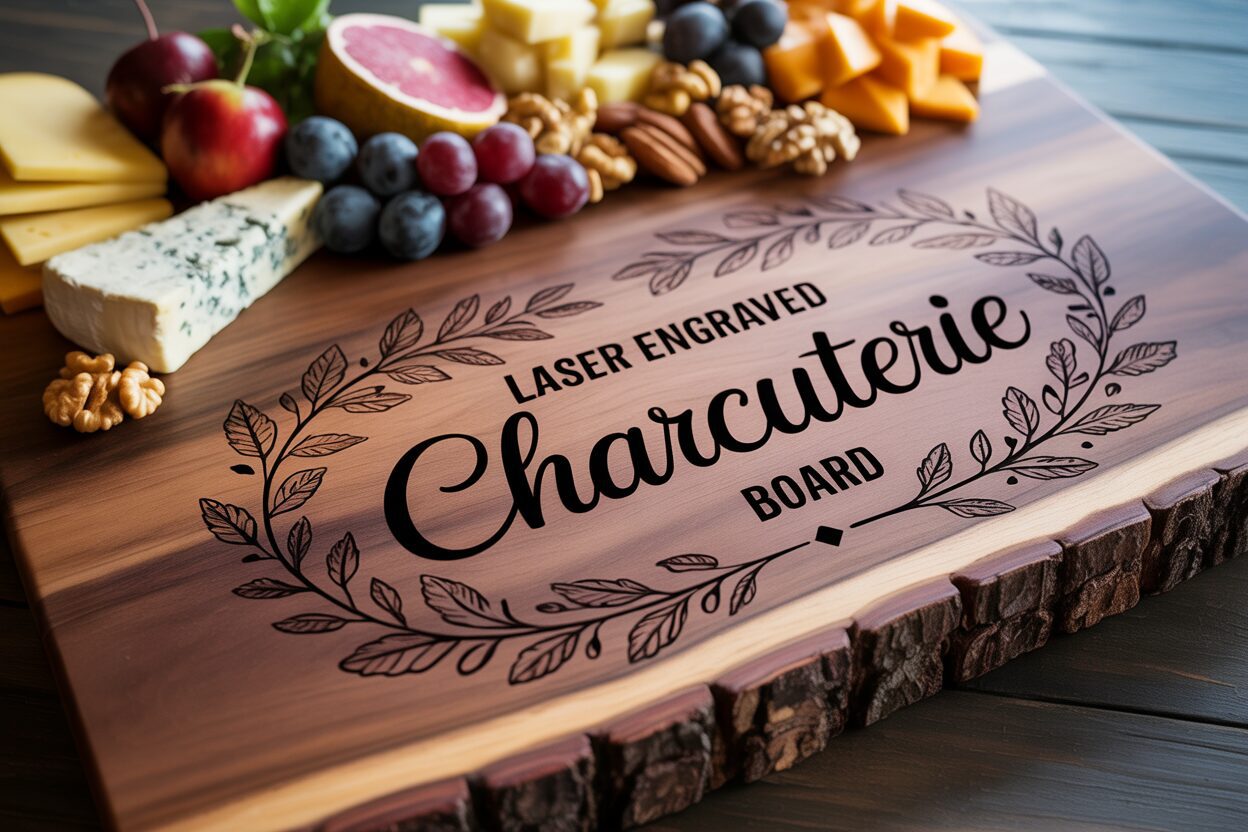
Learn how to create a beautiful and functional laser engraved charcuterie board, perfect for entertaining or as a heartfelt gift. This guide will walk you through selecting the right wood, designing your engraving, and applying a food-safe finish to ensure your creation is both stunning and durable. Let’s start crafting your unique piece.
Interested in more Charcuterie Board? Check out our Charcuterie Board laser file designs: Click here!
Choosing the Perfect Wood for Your Charcuterie Board
The foundation of any exceptional charcuterie board is, quite literally, the wood itself. Your choice will dictate not only the final aesthetic and durability of your piece but also its food safety and how well it accepts a laser engraving. Before you even think about your design, selecting the right slab is the most crucial decision you will make. The primary consideration must always be food safety. For this reason, you should exclusively use non-toxic, closed-grain hardwoods. Closed-grain woods, like the ones we’ll discuss below, have very small pores. This dense structure prevents food particles, bacteria, and moisture from becoming trapped within the wood, making the board more hygienic and easier to clean. Conversely, open-grain woods like Red Oak and Ash have large, porous structures that can harbor germs and are not suitable for direct food contact.
Popular Wood Choices for Engraving
With food safety covered, let’s explore the top contenders for a laser engraved charcuterie board, each offering a unique canvas for your creativity.
- Maple: The High-Contrast Classic. Hard Maple is the go-to choice for many professional board makers, and for good reason. It is incredibly dense and durable, meaning it stands up well to knife use and daily wear. Its most significant advantage for laser engraving is its pale, creamy color and subtle grain pattern. When hit with the laser, maple produces a rich, dark brown or black burn, creating a sharp, high-contrast image that makes intricate text and detailed logos pop. If your design features fine lines or delicate elements, maple is an unparalleled choice for clarity.
- Cherry: The Warm and Elegant Option. Cherry offers a beautiful balance of workability and elegance. It’s slightly softer than maple but still perfectly durable for a serving board. Its hallmark is its warm, reddish-brown hue and smooth, satin-like texture. Over time and with exposure to light, cherry develops a deeper, richer patina that is highly prized. For laser engraving, it provides a beautiful, deep-toned mark that is slightly more subtle than on maple but exudes a sense of warmth and sophistication. The contrast is excellent, making it a versatile choice for a wide range of designs on your personalized charcuterie board.
- Walnut: The Sophisticated Statement. For a darker, more dramatic look, nothing beats walnut. Its rich, chocolate-brown colors, often highlighted with complex swirls and lighter sapwood streaks, make every board a unique piece of art. As a naturally dark wood, the laser engraving effect is more subtle and tonal. Instead of a stark black burn, you get a slightly darker shade of brown, creating a sophisticated, low-contrast “brand.” This makes walnut ideal for bold graphics, monograms, and minimalist designs where the wood’s natural beauty remains the star of the show.
The Unique Appeal of a Live Edge Charcuterie Board
For a truly one-of-a-kind piece, consider a live edge charcuterie board. The term “live edge” refers to a slab of wood where the natural, gnarled edge of the tree is left intact rather than being cut into a straight line. This approach celebrates the organic and rustic character of the wood, ensuring no two boards are ever identical. A live edge transforms your charcuterie board from a simple serving platter into a functional work of art. When engraving a live edge board, the design often works in harmony with the natural curves and flow of the wood, creating a stunning centerpiece that is both beautiful and personal.
Sourcing Your Perfect Wood Blank
Finding a high-quality wood blank is easier than ever. Start by checking with local lumberyards or sawmills, as they often have unique slabs, including live edge pieces, and can offer expert advice. Woodworking supply stores, both local and online, are excellent sources for pre-surfaced and dimensioned blanks that are ready for engraving. When selecting your piece, ensure it is kiln-dried to prevent future warping or cracking. Place the board on a flat surface to check for any rocking or twisting, as a flat surface is critical for achieving a consistent and even engraving.
Designing Your Custom Engraving
With your perfect slab of wood in hand, the next step is to bring your vision to life through a well-crafted design. This is where you transform a simple board into a custom cutting board with engraving that tells a story. Whether you’re an experienced graphic designer or a complete novice, creating a beautiful and engravable file is entirely achievable. The key to a professional-looking result lies in using the correct file type. For laser engraving, vector files are vastly superior to standard image files like JPEGs or PNGs. This is why searching for charcuterie board svg files is an excellent starting point. An SVG (Scalable Vector Graphic) is a design built from mathematical paths and lines, not pixels. This means you can scale it to any size without losing a shred of quality, ensuring the laser follows a perfectly crisp, clean path. Many online marketplaces and design communities offer vast libraries of SVG files, from intricate floral wreaths to witty kitchen quotes, that you can purchase or download for free.
Personalizing Your Masterpiece
The true beauty of a custom board lies in its personalization. This is your opportunity to create something unique and meaningful. Consider who the board is for and what the occasion is. Popular personalization options include:
- Monograms and Names: A classic choice for wedding, anniversary, or housewarming gifts. Engraving a family name and an “established” date creates an instant heirloom.
- Meaningful Coordinates: The geographic coordinates of a first home, a wedding venue, or a special location adds a wonderfully sentimental and modern touch.
- Handwritten Recipes: You can scan a beloved family recipe card (especially one in a relative’s handwriting), trace it in design software, and engrave it directly onto the board. This creates an incredibly personal and functional piece of art.
- Intricate Patterns: For a purely decorative approach, consider geometric patterns, mandalas, or botanical illustrations. These can be placed in a corner or as a border to frame the serving area.
To create or edit these designs, you’ll need vector design software. Professional programs like Adobe Illustrator and CorelDRAW are industry standards, but fantastic free alternatives like Inkscape provide all the tools you need. For simpler text-based designs, even the software that comes with your laser, such as LightBurn, often has robust design capabilities.
Preparing Your File for Engraving
Once your design is finalized, careful preparation is crucial. First, physically measure your board and create a digital artboard or canvas in your software of the exact same dimensions. This allows you to size and place your design with perfect accuracy. Consider the board’s use; placing a design in a corner or along an edge ensures it remains visible even when the board is covered with delicious treats. A large, centered design makes a bold statement but will be obscured during serving. Before sending the file to the laser, make sure all text is converted to paths or outlines. This turns the letters into shapes, so you won’t have any font-related issues. Finally, you must dial in your laser settings. The engraved result is a delicate balance between power and speed. Higher power and slower speeds produce a deeper, darker burn, while lower power and faster speeds create a lighter mark. The ideal settings vary dramatically depending on the wood you chose. Walnut, being dark, requires different settings than maple to achieve visible contrast. The most critical rule is to always run a test engraving on a scrap piece of the same wood before starting on your final board. This small step allows you to perfect the depth and contrast, preventing a costly mistake and ensuring your masterpiece comes out exactly as you envisioned.
The Laser Engraving Process and Best Practices
With your digital design perfected, it is time to move to the laser and bring your creation to life. This stage is a blend of precision and patience, where proper setup and testing are paramount to achieving a flawless result. Before you even turn on the laser, your first priority is safety. Ensure your laser cutter’s ventilation system is properly connected and running effectively to exhaust all smoke and fumes outside. Wood smoke contains particulates and compounds you do not want to breathe. Always have a fire extinguisher rated for electrical equipment nearby, and never, ever leave the machine running unattended.
Machine Setup: Securing and Focusing
Your first step inside the machine is to create a stable, level surface for your board. Place your charcuterie board on the laser bed. If it’s perfectly flat, it may stay in place on its own, but it’s best practice to secure it with honeycomb hold-down pins or a custom-made jig to prevent any shifting during the engraving process. For a warped or live edge board that doesn’t sit perfectly flat, use shims to level the engraving area as much as possible. An unlevel surface will lead to inconsistent focus and, therefore, an uneven engraving. Next, you must set the correct focal distance—the precise distance from the laser lens to the surface of the wood. An improperly focused laser is the number one cause of poor-quality engraving. Whether your machine has an auto-focus probe or uses a manual focus tool, this step is non-negotiable. A sharp, focused beam creates crisp, clean lines; an unfocused beam produces a blurry, weak mark with little detail.
The All-Important Test Engraving
As mentioned previously, you must perform a test run on a scrap piece of the exact same wood that has been prepared in the same way as your final board. This is where you will fine-tune your settings. Instead of just engraving a small part of your design, a more effective method is to create a “power/speed grid” in your laser software. This grid engraves a series of small squares, each with a different combination of power and speed settings. This gives you a comprehensive visual reference for how the wood reacts.
- For Maple: You are looking for a dark, chocolate-brown burn with minimal charring. If the edges of the engraved square are heavily scorched or “fuzzy,” your power is too high or your speed is too slow.
- For Cherry: The goal is a rich, reddish-brown engrave that is a few shades darker than the wood itself. The contrast is naturally more subtle than on maple.
- For Walnut: You want a clean, dark-brown mark that is clearly legible but doesn’t overpower the wood’s natural grain. The engraving on walnut is tonal, so avoid excessively high power which can obliterate fine details.
Pay attention to the DPI (Dots Per Inch) setting as well. For most vector graphics and text, a setting between 300 and 600 DPI is ideal. Higher settings increase detail but also significantly increase engraving time and the amount of heat applied to the wood.
Once you have identified the perfect settings from your test grid, run your final job on the laser engraved charcuterie board. After the laser has finished, allow a minute for the ventilation to clear any remaining smoke before opening the lid. A high-quality engraving will have sharp, well-defined edges, consistent color and depth, and no significant scorching or resinous residue around the design. A poor engraving might look blurry (a focus issue), have a burnt “halo” around it (power too high/speed too slow), or appear too light and faint (power too low/speed too high). By taking the time to set up and test methodically, you ensure your final engraving is a mark of professional quality.
Applying a Food-Safe Finish
After the laser has cooled and the scent of freshly engraved wood fills the air, your project is not yet complete. The final, critical step is to apply a finish. This isn’t just for aesthetics; it is an essential process that protects the wood, enhances the beauty of your engraving, and most importantly, makes your board safe for contact with food. Without a proper finish, the wood’s open pores would quickly absorb moisture, oils, and bacteria from food, leading to staining, warping, and potential contamination. Never use finishes like polyurethane or varnish, as they are not food-safe. You must exclusively use a non-toxic, non-rancidifying food safe wood finish. This crucial step will transform your project into a durable and functional personalized charcuterie board.
Choosing Your Food-Safe Finish
- Food-Grade Mineral Oil: This is the most common and fundamental choice. It is an inert, non-toxic, and flavorless oil that will not go rancid like cooking oils (e.g., olive or vegetable oil) will. Mineral oil penetrates deep into the wood fibers, hydrating them and preventing the board from drying out and cracking. It also provides the initial “pop” that darkens the wood and makes the grain and your engraving stand out beautifully.
- Beeswax: While mineral oil soaks in, beeswax works by creating a protective barrier on the surface. It adds a layer of water resistance and fills in the microscopic pores of the wood, further preventing bacteria from finding a home. It also gives the board a lovely, soft, satin sheen and a smooth feel. Beeswax is typically used in conjunction with mineral oil, not as a standalone finish.
- Board Creams and Conditioners: These products offer the best of both worlds. They are typically a pre-mixed blend of food-grade mineral oil and beeswax (and sometimes other waxes like carnauba). This combination provides deep conditioning from the oil and a durable, water-repellent surface finish from the wax, all in one easy application. For a premium result, a high-quality board cream is an excellent investment.
The Finishing Process: A Step-by-Step Guide
Applying the finish is a simple but rewarding process. Before you begin, gently clean the board with a soft, lint-free cloth to remove any dust or fine residue left over from the engraving process.
- Apply the Finish Generously: Using a clean cloth, apply a liberal amount of your chosen mineral oil or board cream to the entire surface. Don’t be shy; the wood, especially after its first finish, will be very thirsty. Rub the finish into the wood using a circular motion, ensuring you cover every surface—the top, bottom, all edges, and especially inside the engraved design itself.
- Let it Penetrate: This is the most important part. Set the board aside and let the finish soak in. For mineral oil, you should allow at least 4-6 hours, but letting it sit overnight is even better. You will literally see the oil absorb into the wood.
- Buff to a Sheen: After the finish has had ample time to penetrate, there will be an excess film on the surface. Take another clean, dry, lint-free cloth and buff the board vigorously. Rub with the grain until the surface no longer feels greasy or oily. This action removes the excess and polishes the wax, leaving a beautiful, silky-smooth sheen that feels wonderful to the touch.
For a brand-new board, it’s wise to repeat this process two or three times to fully season the wood. This ensures maximum protection and brings out the deepest color and character of your personalized masterpiece, making it ready for its grand debut.
Caring for Your Engraved Charcuterie Board
You have invested time and creativity to produce a stunning laser engraved charcuterie board; now, a little bit of care will ensure it remains a beautiful and functional centerpiece for years to come. Proper maintenance is not complicated, but it is crucial for preserving the integrity of the wood and the clarity of your design. The single most important rule is to protect your board from extreme heat and prolonged exposure to water, which are the primary enemies of natural wood.
The Do’s and Don’ts of Daily Cleaning
Following a few simple rules after each use will make all the difference in the longevity of your custom cutting board with engraving.
- DO hand-wash your board. After use, scrape off any food remnants. Then, use a soft sponge or cloth with a small amount of mild dish soap and warm water to gently wash all surfaces.
- DO pay attention to the engraved area. For deep or intricate engravings where food particles might settle, use a soft-bristled brush (a gentle vegetable brush works perfectly) to clean out the details without scratching the wood.
- DO dry your board immediately and thoroughly. After rinsing, use a clean towel to dry the entire board. Once towel-dried, stand it on its edge in a dish rack to allow for complete air circulation, ensuring no moisture is trapped underneath.
- DON’T ever put your wooden board in the dishwasher. The intense heat, harsh detergents, and prolonged water saturation will strip the wood of its natural oils, causing it to warp, crack, and split, irreparably damaging both the board and the engraving.
- DON’T submerge or soak the board in the sink. This forces an excessive amount of water deep into the wood grain, which will lead to the same disastrous effects as a dishwasher.
Re-seasoning: The Key to Long-Term Health
The beautiful finish you applied is not permanent; it’s a protective layer that needs to be replenished. Over time, with washing and use, the wood will begin to dry out. The key is to reapply a food safe wood finish before the wood becomes too thirsty. You will know it’s time when the wood starts to look dull or lighter in color, or when water no longer beads up on the surface. A good rule of thumb is to re-season your board once a month if it’s used frequently, or whenever it looks dry.
The process is exactly the same as the initial application:
- Make sure your board is completely clean and dry.
- Using a clean, soft cloth, apply a generous layer of your board cream or food-grade mineral oil to all surfaces. Don’t forget the edges and the engraved areas.
- Let the finish penetrate for at least a few hours, or preferably, overnight. This allows the oil to soak deep into the wood fibers, rehydrating them from within.
- With another clean, dry cloth, buff off any excess oil. Rub with the grain until the board has a rich, satin sheen and no longer feels greasy.
This simple routine of proper cleaning and regular re-seasoning will maintain the protective barrier, keep the wood hydrated and stable, and ensure your custom engraved charcuterie board remains as stunning as the day you made it.
Conclusions
You’ve now mastered the art of creating a laser engraved charcuterie board. From selecting the perfect wood to applying a food safe wood finish, you have the skills to produce a stunning and personalized piece. This project not only enhances your home but also makes for an unforgettable gift, showcasing the beauty of custom craftsmanship.
Frequently Asked Questions
Q: What is the best wood for a high-contrast laser engraving?
A: Hard Maple is the best choice for high-contrast designs. Its pale, creamy color allows the laser to create a rich, dark brown or black burn, making intricate details and text pop clearly.
Q: Can I use a regular JPEG or PNG file for my engraving design?
A: While possible, it is highly discouraged. Vector files like SVG are vastly superior because they are built from mathematical paths, not pixels. This means they can be scaled to any size without losing quality, resulting in a perfectly crisp and clean engraving.
Q: Is it safe to put my wooden charcuterie board in the dishwasher?
A: No, you should never put a wooden board in the dishwasher. The combination of intense heat, harsh detergents, and prolonged water saturation will strip the wood of its protective oils, causing it to warp, crack, and split, permanently ruining the board.
Q: How often should I re-season my engraved board?
A: You should re-season your board whenever it starts to look dull or dry, or when water no longer beads up on the surface. For a frequently used board, a good rule of thumb is to re-apply a food-safe finish about once a month.
Block "subscribe-popup" not found
