
Tutorials
A Beginner’s Guide to Creating a Custom Engraved Charcuterie Board
Mar
Estimated reading time: 7 minutes
Key Takeaways
- Choose the Right Wood: Select closed-grain hardwoods like Maple, Cherry, or Walnut for your charcuterie board. They are food-safe, durable, and provide a clean surface for high-quality laser engraving.
- Optimize Your Design File: Use vector files (SVG, AI) for logos and text to ensure sharp, scalable lines. For images, use high-resolution raster files (300 DPI JPG, PNG) to avoid pixelated results.
- Calibrate Laser Settings: Always test your laser’s power and speed on a scrap piece of the same wood before engraving your final board. Different woods require different settings to achieve the desired depth and color without scorching.
- Apply a Food-Safe Finish: After engraving and cleaning, season the board with food-grade mineral oil and/or a beeswax conditioner. This protects the wood, ensures food safety, and makes your engraved design pop.
Table of Contents
- Choosing the Best Wood for Your Charcuterie Board
- Design Preparation and Laser Engraving Techniques
- Applying a Food Safe Wood Finish
- Conclusions
- Frequently Asked Questions
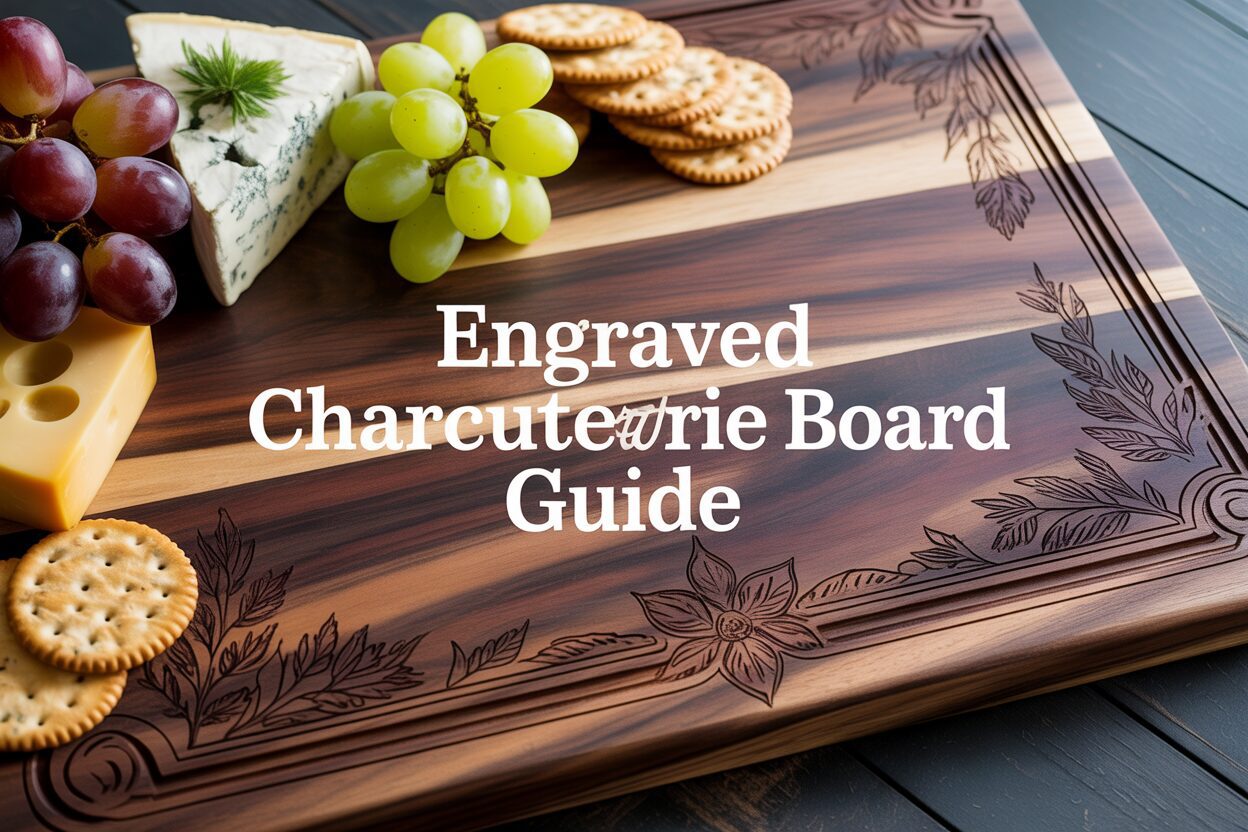
Discover the art of creating a stunning engraved charcuterie board. This guide will walk you through every step, from choosing the best wood for laser engraving to the final touches of finishing the engraved wood. Perfect for DIY enthusiasts and small business owners looking to create personalized gifts or products that are both beautiful and functional.
Interested in more Charcuterie Board? Check out our Charcuterie Board laser file designs: Click here!
Choosing the Best Wood for Your Charcuterie Board
The foundation of any stunning laser engraved cutting board is the wood itself. This choice is not merely about looks; it is a critical decision that impacts food safety, durability, and the quality of your engraved design. The ideal material must be non-toxic, durable enough to withstand knife marks, and, most importantly for our purposes, feature a grain structure that is conducive to laser engraving. For charcuterie boards, this means selecting a hardwood with a closed-grain pattern. Closed-grain woods, like maple, cherry, and walnut, have very small pores. This dense structure prevents bacteria, moisture, and food particles from penetrating the surface, making them significantly more hygienic and easier to clean. Conversely, open-grain woods like red oak have large, porous grains that can trap food and bacteria, making them unsuitable for direct food contact surfaces. Furthermore, the tight, uniform grain of these preferred woods provides a perfect canvas for the laser, allowing it to produce sharp, clean lines and intricate details without the splintering or blotchiness that can occur with softer or more porous woods.
Top Wood Choices for Laser Engraving
When selecting the best wood for laser engraving, three choices consistently stand out for their beauty, safety, and performance: Maple, Cherry, and Walnut. Each offers a unique aesthetic that can elevate your personalized charcuterie board from a simple kitchen tool to a work of art.
- Maple: Often considered the industry standard for cutting boards, Hard Maple is prized for its exceptional durability and light, creamy color. Its hardness resists deep scratches, preserving the board’s surface. For laser engraving, maple’s subtle grain and bright surface create a dramatic, high-contrast effect, making the engraved design pop with dark, crisp lines. It’s a fantastic choice for highly detailed logos, intricate text, or complex patterns that demand clarity.
- Cherry: Known for its warm, reddish-brown hue and smooth, satiny finish, Cherry offers a rich and inviting look. It is slightly softer than maple but still very durable for charcuterie use. What makes cherry truly special is its tendency to darken over time, developing a beautiful, deep patina with exposure to light. The laser engraving on cherry results in a deep, rich tone that provides elegant, moderate contrast against the wood’s natural warmth.
- Walnut: For a truly luxurious and sophisticated board, Walnut is the premier choice. Its deep, chocolate-brown colors, often highlighted by complex grain patterns and lighter sapwood streaks, make every board unique. While it is the softest of the three, it remains a durable hardwood suitable for serving. Engraving on walnut produces a subtle, tone-on-tone effect that is understated and elegant. The design appears as a darker shade of the wood itself, perfect for a refined and high-end aesthetic.
To help you decide, here is a direct comparison of these premium woods:
| Wood Type | Hardness | Grain Pattern | Engraving Contrast | Cost |
|---|---|---|---|---|
| Maple | High (Very Durable) | Subtle, straight, and fine | Very High | Moderate |
| Cherry | Medium (Durable) | Fine, straight, and smooth | Moderate to High | Moderate to High |
| Walnut | Medium (Durable) | Rich, can be straight or wavy | Low to Moderate (Subtle) | High |
Design Preparation and Laser Engraving Techniques
With your perfect piece of wood selected, the next step is to translate your creative vision into a digital file and prepare the laser for engraving. The quality of your final engraved charcuterie board is directly tied to the precision of your design file and the calibration of your machine. A well-prepared file ensures the laser produces clean lines and accurate details, bringing your design to life exactly as you imagined.
Optimizing Your Digital Design
First, you must understand the two primary types of image files used in laser engraving: Vector and Raster.
- Vector files (like SVG, AI, or DXF) are created from mathematical paths and lines. They are ideal for logos, text, and line art because they can be scaled to any size without losing quality. The laser follows these paths directly, resulting in exceptionally sharp and clean edges. When working with text, it is crucial to convert it to paths or outlines in your design software. This turns the letters into shapes, ensuring the laser engraver reads them correctly, even if it doesn’t have the specific font installed.
- Raster files (like JPG, PNG, or BMP) are made of pixels. They are used for photographs or complex images with gradients and shading. The laser engraves these images line by line, similar to how an inkjet printer works. For a high-quality raster engraving, your image must have a high resolution, typically 300 DPI (dots per inch) or higher. A low-resolution file will result in a pixelated and blurry engraving. For most custom monograms and text-based designs on a laser engraved cutting board, a vector file is strongly recommended.
Calibrating Your Laser for Different Woods
Once your design is finalized, it’s time to set up the laser engraver. The most critical settings are Power and Speed. These two variables work together to determine the depth and darkness of your engraving. Higher power and slower speed result in a deeper, darker burn, while lower power and faster speed produce a lighter mark. Finding the perfect balance is key to achieving a professional finish without scorching the wood. A common beginner mistake is using too much power, which can create excessive charring and “bleeding” of the burn into the surrounding wood grain.
The optimal settings will vary significantly based on the wood you chose in the previous chapter.
- Maple: Being a hard, dense wood, maple requires more energy to mark. You will need to use a higher power setting or a slower speed to achieve a rich, dark contrast. Its light color is forgiving and provides an excellent canvas for high-contrast results.
- Cherry: This wood is softer than maple and will engrave at a lower power setting or a faster speed. Its natural reddish tones produce a beautiful, deep red-brown engraving. Be careful not to overpower it, as it can be more prone to scorching than maple.
- Walnut: As the softest and darkest of the three, walnut requires the least amount of power. The goal here is often a subtle, tone-on-tone effect that looks incredibly elegant. Too much power will create a deep, charred groove that detracts from the wood’s natural beauty.
The golden rule of laser engraving is to always test your settings on a scrap piece of the same wood before running the job on your final board. Create a small test grid with different power and speed combinations to see which one gives you the desired depth, color, and clarity. This small step will save you from potentially ruining your beautiful charcuterie board.
Applying a Food Safe Wood Finish
After the laser has worked its magic and your design is perfectly etched into the wood, you are on the final, crucial step: finishing engraved wood for food use. This stage is not just about aesthetics; it is paramount for safety and longevity. Applying a proper food safe wood finish creates a protective barrier that prevents the wood from drying out and cracking, makes it easier to clean, and ensures that no harmful chemicals leach into the food you serve. Any finish applied to a surface that will have direct contact with food must be 100% non-toxic and safe for consumption. This means common woodworking finishes like polyurethane, lacquer, or stains are completely off the table. Instead, you will use penetrating oils and waxes that nourish the wood from within.
Choosing Your Food-Safe Finish
The most popular and trusted options for finishing a personalized charcuterie board are simple, natural, and effective.
- Mineral Oil: This is the most common and highly recommended choice. It is an inert, colorless, and odorless oil that is completely food-safe. It penetrates deep into the wood fibers, hydrating them and preventing the board from becoming brittle. It is important to use food-grade mineral oil, which is readily available at pharmacies or grocery stores (often sold as a laxative). Do not use vegetable or olive oils, as they can go rancid over time.
- Beeswax: While mineral oil moisturizes, beeswax adds a layer of protection. It helps to seal the pores on the surface, providing a more water-resistant finish and a beautiful, low-gloss sheen. Beeswax is typically melted and mixed with mineral oil to create a softer, spreadable conditioner.
- Cutting Board Conditioners: For convenience, many companies offer pre-made “board creams” or “cutting board conditioners.” These products are almost always a blend of food-grade mineral oil and beeswax (sometimes with the addition of carnauba wax for extra hardness). They offer the benefits of both ingredients in one easy-to-use application.
Step-by-Step Finishing Process
Proper application is key to creating a durable and beautiful finish that makes the grain and your engraving truly pop.
- Post-Engraving Cleanup: Before applying any finish, you must clean the board. The laser engraving process leaves a slight amount of resin and smoke residue. Use a soft-bristled brush (like a toothbrush) to gently scrub the engraved area and remove any loose debris. If there is stubborn residue, you can lightly wipe the surface with a lint-free cloth dampened with isopropyl alcohol. Let it evaporate completely before proceeding.
- Apply the First Coat: Using a clean, lint-free cloth, apply a generous amount of your chosen oil or conditioner to the entire board—top, bottom, and all sides. Don’t be shy; you want the surface to look wet. Pay special attention to the engraved areas, ensuring the finish gets into every crevice.
- Let it Soak: Allow the finish to penetrate the wood for at least 20-30 minutes. For the very first coat on a new engraved charcuterie board, letting it soak overnight is even better. The wood will absorb the oil, hydrating the fibers.
- Buff Off the Excess: After the soaking period, take a fresh, clean cloth and buff the entire board vigorously. You want to remove all excess oil from the surface. The board should feel smooth and hydrated, not sticky or greasy.
- Repeat for Additional Coats: One coat is not enough. Repeat this process two or three more times to ensure the wood is fully seasoned. Each subsequent coat will require less oil as the wood becomes more saturated. A properly finished board will have a deep, rich color and a smooth, satiny feel. The finish will dramatically enhance the contrast of your engraving, making the design stand out against the newly lustrous wood grain. Allow the board to cure for at least 24 hours before its first use.
Conclusions
You now have the knowledge to create a professional-quality engraved charcuterie board. By selecting the right materials and applying a food safe wood finish, you can make a personalized charcuterie board that is safe, durable, and impressive. Continue exploring different designs and woods to perfect your craft and create truly unique pieces for any occasion.
Frequently Asked Questions
Q: What is the best wood for a beginner to use for laser engraving a charcuterie board?
A: Maple is an excellent choice for beginners. Its light color, tight grain, and hardness create high-contrast engravings and are very forgiving with laser power and speed settings, making it easier to achieve a clean result.
Q: Can I use vegetable oil or olive oil to finish my charcuterie board?
A: No. You should not use common cooking oils like vegetable or olive oil because they are not shelf-stable and can become rancid over time. This will create a bad smell and an unpleasant taste on any food served on the board. Always use a non-perishable, food-grade mineral oil.
Q: Why is my engraving blurry or pixelated?
A: If you are using a raster image (like a JPG or PNG), it is likely low resolution. For crisp results, ensure your image is at least 300 DPI (dots per inch). For logos, text, and line art, using a vector file (like an SVG or AI) is always the best option as it will produce perfectly sharp lines regardless of size.
Q: How do I clean my engraved charcuterie board?
A: To clean your board, hand-wash it with mild soap and warm water. Never soak the board in water or put it in a dishwasher, as this will cause it to warp and crack. After washing, dry it immediately and thoroughly with a clean towel. Re-apply a coat of food-safe mineral oil every few months, or whenever the wood looks dry, to maintain its protective finish.
Block "subscribe-popup" not found
